Knowledge Hub / Crest Infosolutions

Partner Spotlight

Hemant Prasad
Chief Executive Officer
Crest Infosolutions Sdn Bhd

Partner Spotlight

Enterprise Content Lake: Govern What You Have First, Modernize What Matters Next


In banking and finance, insurance, fintech, telecommunications, retail and several other enterprises, customer and business documents rarely live in one place. Often overlooked as responsibility of individual business teams, it is spread across legacy ECM systems, collaboration platforms, cloud drives, shared folders, FTP servers, scanned archives, and the databases of line-of-business applications. Over time, this creates a familiar pattern: rising maintenance costs, duplicated information, slower processes, fragmented search, data leak risk and growing compliance exposure. In most cases, the customer and business documents live for forever due to lack of control on federated silos and blind spots in data governance.


The problem is not only storage sprawl, it’s the loss of control.


An Enterprise Content Lake offers a practical answer. Instead of forcing a risky, high-cost “big bang” migration, it creates a governed operating layer across federated content silos first. This gives organizations a single pane of glass to discover, classify, search, secure, and govern documents across multiple repositories while allowing content to remain where it must for operational, legal, or business reasons.


This approach helps enterprises apply consistent classification, retention, access, and policy controls across distributed content estates. It also provides a unified view of customer and business documents, reducing the time teams spend hunting for files, reconciling versions, and manually moving information between systems.


Just as importantly, it creates the foundation for trustworthy AI.


Most AI and RAG initiatives struggle because enterprise data is scattered, duplicated, poorly classified, and difficult to govern. By connecting content sources into a governed content layer, organizations can improve metadata consistency, reduce duplication, strengthen access control, and expose higher-trust content to downstream AI use cases. The result is faster time to value for business search, service operations, case work, and AI-driven knowledge access.


The smartest modernization strategy is not to migrate everything at once. It is to govern in place first, rationalize what is redundant second, and selectively migrate where the value is clear.


That is how fragmented repositories become a controlled, compliant, and AI-ready enterprise asset.


Knowledge Hub / Origina

Partner Spotlight

Nancy Maluso
Executive Vice President, Enterprise Transformation
Origina

Partner Spotlight

Designing Your Digital Destiny: A Framework for Independence in the AI Era


As digital transformation accelerates, organizations are confronting a growing strategic imperative: establishing digital sovereignty. More than a regulatory concept, digital sovereignty represents the ability of enterprises and nations to control and protect their data, infrastructure, and software in accordance with local laws, values, and operational requirements. In practice, it means understanding precisely where data resides, who has access to it, and how technological dependencies influence business continuity, competitive advantage, and customer trust.

   

This need for control is increasingly difficult to achieve in a borderless digital ecosystem dominated by a small number of megavendors. With more than 450 of the world’s top 1,000 technology firms headquartered in the United States and another significant cluster in China, enterprises across Europe, Asia, and even the U.S. itself are evaluating the risks of concentrated technological power. Vendor-driven migrations, forced upgrades, and cloud-centric operational models often collide with enterprise roadmaps, budgets, and long-term architectural needs, raising concerns about stability, cost escalation, and loss of control.

   

Regulators have responded accordingly. The European Union has introduced ambitious frameworks such as Gaia-X alongside the Data Act and AI Act; India and China enforce strict data localization laws. While Southeast Asian countries have taken a more balanced approach, this expanding patchwork requires global CIOs to navigate a complex landscape of data residency rules, sovereignty requirements, and compliance obligations, often across multiple jurisdictions simultaneously. The cost of noncompliance, demonstrated through GDPR and CCPA enforcement, has made sovereignty a board-level priority.


At the same time, evolving technical risks expose the fragility of overconcentrated digital supply chains. Outages at hyper-scalers can disrupt financial services, transportation, consumer platforms, and critical infrastructure for hours. Concerns about the security of globally sourced hardware have renewed interest in regional supply chains. High-profile abuses of personal data, such as the Cambridge Analytica scandal, have eroded trust and reinforced the need for transparency, governance, and localized control.


Origina’s explores the forces driving this global movement and provides pragmatic guidance for CIOs seeking to build vendor-independent, compliant, and resilient digital environments, while preserving the agility and innovation their organizations demand.

IDC and Neo4j Roundtable

5 Jun 2026 JW Marriott Hotel New Delhi Aerocity

IDC and Neo4j Roundtable

Driving Enterprise AI and Insights

5 Jun 2026 JW Marriott Hotel New Delhi Aerocity

In Partnership With

Logo

Driving Enterprise AI and Insights

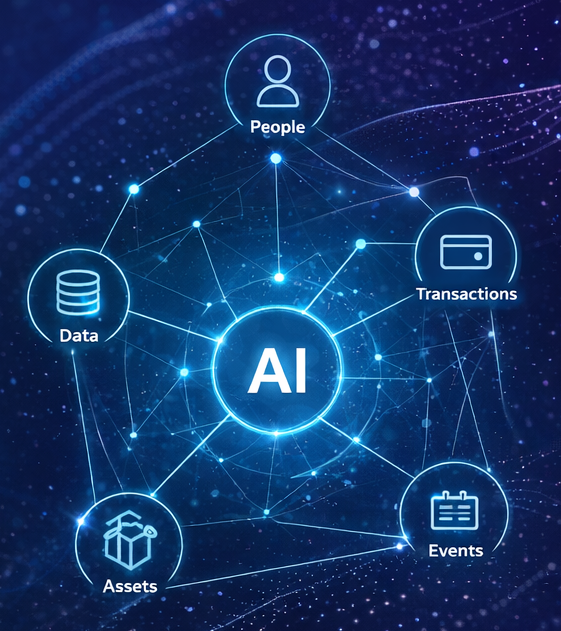
India’s rapid digital transformation driven by real-time payments, digital identity platforms, and expanding digital ecosystems, is reshaping how financial transactions, services, and interactions take place. However, this acceleration is also increasing the complexity and scale of fraud, financial crime, and identity-related risks.


Traditional fraud detection approaches often rely on rules and static models that struggle to detect sophisticated schemes spanning multiple accounts, devices, identities, and transactions.

IDC research highlights the growing importance of stronger data foundations for AI-driven risk management. By 2027, organisations that fail to prioritise high-quality, AI-ready data will experience up to a 20% productivity loss, as AI and analytics initiatives struggle with fragmented data environments. At the same time, IDC predicts that end-to-end observability across the data value chain will improve AI proof-of-concept to production success rates by up to 60% in APEJ organisations by 2026.


This executive roundtable will bring together CIOs and technology leaders to explore how connected data and graph intelligence are helping organisations uncover hidden fraud patterns, strengthen investigative analytics, and enable AI systems to operate with greater context and accuracy. Drawing on IDC research and enterprise experiences, the discussion will focus on how organisations can build more explainable, context-aware, and scalable fraud detection systems.

Why Attend

  • Gain Research Insights: Learn from IDC’s latest global and APeJ research on AI and GenAI adoption, trends, and enterprise challenges.
  • Understand Connected Data: Discover why connected intelligence is critical for scaling AI and improving decision-making.
  • See Graph Technology in Action: Learn how graph-based approaches help organizations enhance AI accuracy, explainability, and trust.

Agenda

IDC and Neo4j Roundtable

One Day Event

6:00 pm

Registration & Networking

6:30 pm

Welcome Address

Sakshi Grover

Sakshi Grover

Senior Research Manager, Cybersecurity Services, IDC Asia/Pacific

6:35 pm

The Future of Enterprise AI: From Data Silos to Connected Intelligence

As AI adoption accelerates, data silos remain a major barrier to scale. This session explores how enterprises can unify fragmented data, enable real-time insights, and build connected intelligence that drives smarter decisions and business growth.

Sakshi Grover

Sakshi Grover

Senior Research Manager, Cybersecurity Services, IDC Asia/Pacific

6:45 pm

Graph Intelligence in Action: Real-World AI Use Cases Across Industries

Graph intelligence is transforming how organisations uncover relationships, detect patterns, and generate actionable insights.

7:00 pm

Open Discussion: Scaling Trusted GenAI: Why Connected Data Is the Missing Link

Explore how connected, contextual data helps enterprises scale Generative AI responsibly by improving accuracy, trust, and governance while reducing risk.

Sakshi Grover

Sakshi Grover

Senior Research Manager, Cybersecurity Services, IDC Asia/Pacific

8:00 pm

Summary & Close

Sakshi Grover

Sakshi Grover

Senior Research Manager, Cybersecurity Services, IDC Asia/Pacific

8:10 pm

Dinner and Networking

Speaker

Sakshi Grover

Sakshi Grover

Senior Research Manager, Cybersecurity Services

IDC Asia/Pacific

Read bio

Partner

In Partnership With

Venue

JW Marriott Hotel

Meeting Room – Studio 05 & 06
Asset Area 4 – Hospitality District Delhi, Aerocity, New Delhi – 110037

Speakers

Speakers

Speakers
Alejandro Florean Rodriguez

Alejandro Florean Rodriguez

Vice President of Custom Solutions LatAm & Country Manager Mexico

IDC

Read bio

Claudia Medina

Claudia Medina

Director, Data & Analytics

IDC Mexico

Read bio

Alberto Arellano

Alberto Arellano

Infrastructure Director

IDC

Read bio

Marco Tena

Marco Tena

Director de ingeniería,

HPE Networking

Read bio

Julio César S. Lozano Vázquez

Julio César S. Lozano Vázquez

Strategic Account Manager

Manage Engine

Read bio

Gabriel Gadala

Gabriel Gadala

Senior Enterprise Leader, LATAM

BlueCat Networks

Read bio

Partners

Platinum Partners

Gold Partners

Silver Partners

Zabbix SIA is the creator of one of the leading network, server, and service monitoring tools.
Learn More

Expo partners

Knowledge Hub / SearchUnify

Partner Spotlight

SearchUnify

Partner Spotlight

Agentic Architecture for Enterprise Customer Support: A Lever for the Outcomes You're Already Accountable For

CIOs in high-stakes industries are managing more competing priorities than ever — security, cloud, data governance, AI risk, workforce transformation. Customer support rarely sits at the top of that stack, and that’s entirely rational. Bandwidth is finite. Every decision to defer something is also a decision to protect something else.


But support carries a quiet cost when deprioritized. When enterprise queries go unresolved, compliance questions fall through the cracks, or renewal conversations stall, the effects don’t stay in the support queue. They surface in churn numbers, audit findings, and board conversations about retention and operational risk — metrics you’re already accountable for, regardless of whether support is on your roadmap.


The question isn’t whether to prioritize support. It’s whether the infrastructure underneath it is quietly undermining outcomes you’re already responsible for.


From Patchwork to Architecture


Most organizations built their current support setup incrementally — a chatbot here, a knowledge base there. The result is fragmented, costly to maintain, and difficult to govern. Agentic systems change the calculus: rather than simply retrieving answers, they reason across context, invoke enterprise tools within a single workflow, and make calibrated decisions about when to resolve autonomously versus when to escalate gracefully to a specialist; with full context intact, not abandoned mid-resolution.


Three design decisions determine whether this works in practice: memory precision (retrieval rigorous enough for regulated environments), tool governance (every action surface scoped and audited like any privileged user), and escalation design treated as a feature, not a fallback. Organizations that get these right see the architecture compound in value over time – building a knowledge layer that becomes increasingly difficult for competitors to replicate.


A Governance Proof Point, Not Another Risk


For CIOs already navigating AI governance at the board level, a well-architected support layer can become a proof point rather than a liability — demonstrating auditability, immutable audit trails, and responsible deployment at scale.


The investment case isn’t built on support transformation for its own sake. It’s built on protecting the resilience, cost control, and risk reduction outcomes you’re already accountable for.


IDC, AWS & Kloia Executive Dinner

7 May 2026 Covent Garden Hotel

IDC, AWS & Kloia Executive Dinner

7 May 2026 Covent Garden Hotel
Logo Logo

Cloud Value Realisation: Best Practices Discussion for Migration, Modernization and Cost Optimization

C-suites across verticals and company sizes are looking to re-invent their business with AI. To this effect, three domains of focus for IT leaders are: IT modernization, cost optimization, and ensuring resilience and control.

As the economic climate tightens, IT and business leaders are facing a sobering reality: moving to the cloud didn’t automatically result in a smaller bill or faster innovation. Today, the conversation has shifted from “How do we get there?” to “How do we actually realize the value we were promised?”

Only 12% of organizations IDC surveyed in September 2025 (IDC Multicloud Strategies Survey, EMEA) identified themselves as having an IT architecture that is mature, optimized and tightly aligned to business value or innovation.

If speed of adoption and scale of use were top considerations in the last “cloud first” decade, this decade it is about adding control with cloud economics, efficiency and sustainability.

These value pillars are driving IT investment decisions today. In fact, based on an IDC survey, “value for money” was among the highest rated attribute for selecting a cloud technology vendor partner.  About a quarter of IT leaders IDC surveyed in December 2025 said they are “under utilizing or wasting” over 31% of their total cloud spend.

IDC, in partnership with Kloia and AWS, invites you to an exclusive executive roundtable designed to peel back the layers of Cloud Value Realization. The timing is pivotal as cloud and AI strategies take centerstage. In fact, workload modernization has become a high or top priority for 7 out of every 10 organizations in 2026, according to IDC research. The key question is to make the transformation and migration strategy cost-effective and successful. The actual ROI is often lost in the “messy middle”, the technical debt, unoptimized database workloads, skills shortages to operate efficiently in the cloud and legacy code that prevents true cloud-native agility.

We will address the “bill shock” head-on. In the current market, the long-term solution lies in FinOps-first modernization. We will explore how to move beyond simple “lift and shift”. We will discuss how to bridge the gap between business mandates and the engineering-level execution required to meet them. This is an opportunity to engage in a candid dialogue about the architectural discipline needed to turn the cloud into a genuine profit centre rather than a growing line item.

Agenda

IDC, AWS & Kloia Executive Dinner

One Day Event

6:00 pm

Welcome & Champagne Reception

6:30 pm

Welcome Address from IDC, AWS & Kloia

Archana Venkatraman

Archana Venkatraman

Senior Director Research, Cloud Data Management, IDC

Dorian Sezen

Dorian Sezen

Partner & Founder, Kloia

6:45 pm

Delegate Introductions

7:00 pm

Starter Discussion Topic & Feedback – Change Imperatives

What are the current challenges and limitations of existing IT environment in meeting business expectations? What are the pressures on IT teams? How to build the case for IT modernization to budget holders?

7:35 pm

Main Course Discussion Topic & Feedback – Hallmarks of True Cloud Migration, Modernization and Operations

From taking workload inventory to engineering migration and focusing on Day 2 operations that include security, cost optimization and continuous, transparent business value. How to work practical metrics and KPIs to track cloud value realization. How can leaders shift from reactive cost-cutting to proactive cost-engineering? What are low-hanging fruits to quickly optimise and how to set up FinOps discipline.

8:15 pm

Dessert Discussion Topic & Feedback – Execution Excellence

There is often a disconnect between the vision and the technical execution on the ground. How do you ensure your cloud strategy doesn’t fail at the implementation phase due to a lack of deep engineering talent? What are the best practices on building or partnering for “Deep Tech” squads that can handle complex migrations that standard cloud engineers might avoid.

8:45 pm

Coffee Served & Evaluations Forms Distributed

9:00 pm

Event Close

Speakers

Archana Venkatraman

Archana Venkatraman

Senior Director Research, Cloud Data Management

IDC

Read bio

Dorian Sezen

Dorian Sezen

Partner & Founder

Kloia

Read bio

Richard Lees

Richard Lees

Head of GTM Strategy and BD – Migration and Modernisation, EMEA

AWS

Read bio

Partners

In Association With

Venue

Covent Garden Hotel

10 Monmouth St, London WC2H 9HB

Financial Services Summit India

Financial Services Summit India

12 Jun 2026 The St. Regis Mumbai
Slide
Slide
Slide
Slide

Building Resilient Finance in the Age of Intelligence

In an era of accelerating disruption and hyper-competition, financial services institutions in India face a powerful imperative: not just to transform but to thrive. Financial Services Summit India 2026 brings together the country’s most senior technology and business leaders from banks, insurers, capital-markets firms and payments organizations to explore how digital, data and AI-driven strategies can deliver resilient growth, operational excellence and customer-centric innovation.

According to IDC’s latest research for the Asia-Pacific banking sector, software investments are expected to grow at a CAGR of 21.1% by 2027, highlighting the importance of big data, analytics and AI-powered solutions for financial institutions. IDC further projects that digital transformation spending by Asia-Pacific banks will rise from around $30.4 billion today to $48.6 billion by 2027, reflecting the urgency of the agenda.

Join industry peers at Financial Services Summit India to explore practical strategies for scaling AI, enabling real-time financial ecosystems, and building resilient, future-ready institutions in India.


The event will spotlight critical themes such as:​

  • AI and machine learning truly delivering outcomes (not just pilots)​
  • Reinventing the core infrastructure for agility, scalability and resilience​
  • Orchestrating data, analytics and cloud to unlock personalized customer experiences​
  • Strengthening trust, security and operational resilience amid regulatory and geopolitical flux​
  • Enabling embedded finance, open ecosystems and payments transformation

Expert Perspectives

IDC analysts and industry experts will share guidance on how to architect adaptive technology foundations, reduce technical debt, and operationalize AI responsibly while aligning IT with strategic business goals. Through keynote presentations, panels, and peer-led discussions, the Summit equips CIOs with the research, frameworks, and leadership tools to build resilient, secure, and innovation-ready enterprises for 2026 and beyond.​

5:40 pm

IDC Keynote: Accelerating India’s Transition to a Global Financial Services Superpower. Technology Strategies Gearing India for the Future

India is rapidly positioning itself as a global financial services powerhouse, driven by digital public infrastructure, regulatory innovation, and ecosystem-led growth. This keynote will explore how financial institutions can leverage AI, data, and platform-based architectures to scale innovation, strengthen resilience, and compete on a global stage.
The session will also highlight the strategic technology priorities required to sustain this momentum, balancing growth with trust, compliance, and long-term operational stability.

Dr. Christopher Lee Marshall | IDC

Read Bio
Dr. Christopher Lee Marshall

Speakers

Dr. Christopher Lee Marshall

Dr. Christopher Lee Marshall

Vice President, Data, Analytics, AI, Sustainability, and Industry Research

IDC

Read bio

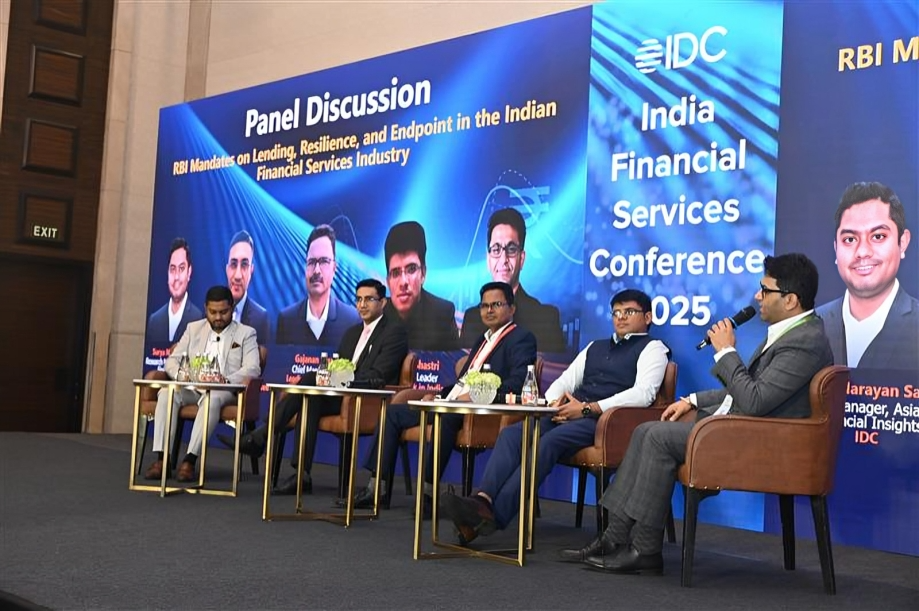
Event Highlights 2025

Our Partners

Venue

The St. Regis Mumbai

462, Senapati Bapat Marg, Lower Parel, Mumbai, Maharashtra 400013, India

Be Part of it!

Register Now

Reimagining the Future of BFSI

28 Apr 2026 Shangri-La The Fort, Manila

Reimagining the Future of BFSI

28 Apr 2026 Shangri-La The Fort, Manila

In Partnership With

Logo

Building Resilient, Intelligent, and Scalable Financial Institutions

The Philippine financial sector has entered its second wave of transformation. Over 50% of large enterprises are operating in the cloud. Seven in ten organisations are deploying GenAI-enhanced applications.


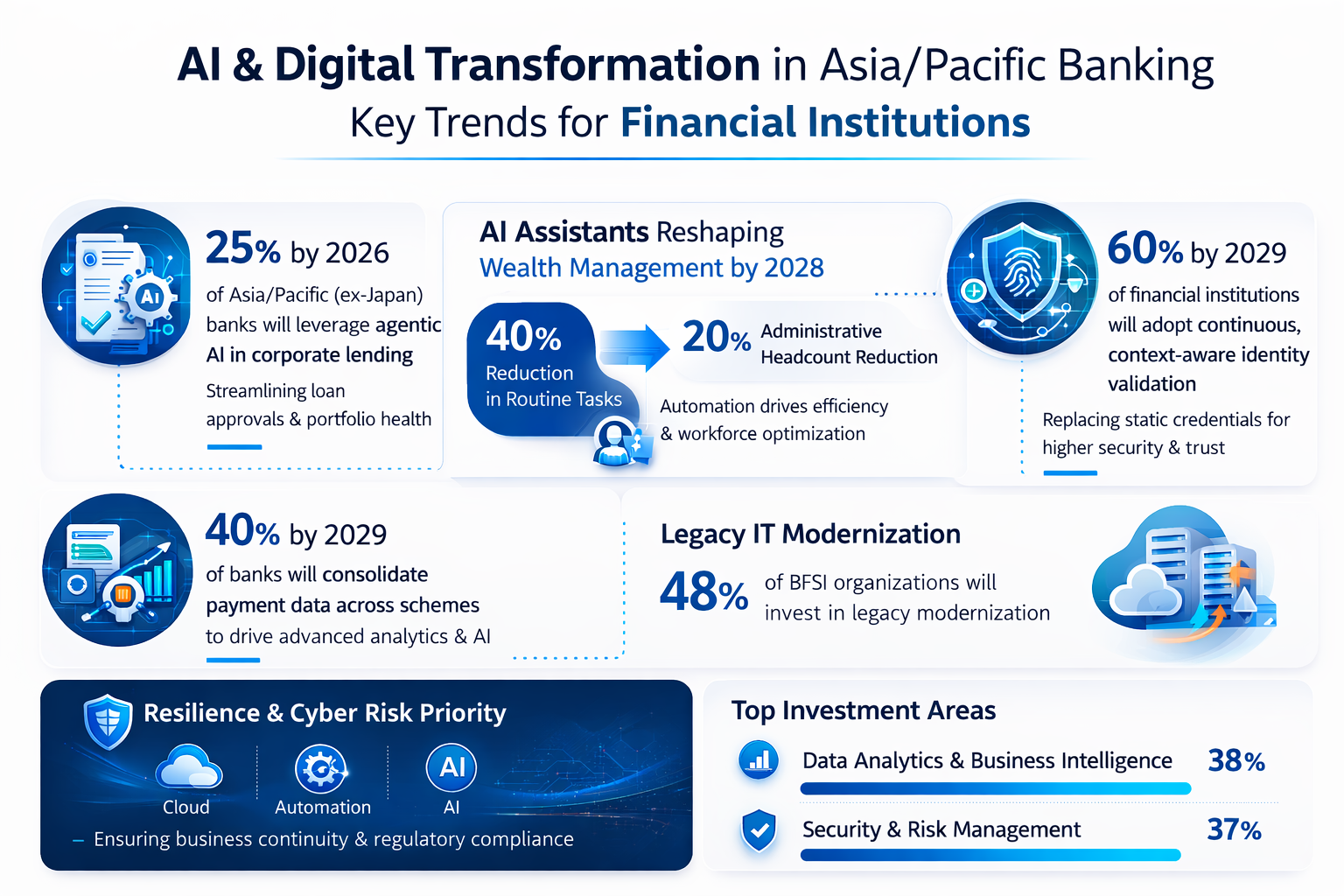
The question is no longer adoption. It is reinvention. By 2026, 25% of Asia-Pacific banks are expected to deploy agentic AI in corporate lending, accelerating approvals, improving portfolio health, and reshaping risk management models.


At the same time, regulatory scrutiny around operational resilience, cyber readiness, and responsible AI governance is intensifying. Innovation without control is no longer viable. Growth must be matched by trust.


Yet nearly half of BFSI institutions across the region are still navigating legacy modernisation, balancing scale with operational continuity.


This executive roundtable convenes CIOs, and Senior IT leaders to examine how Philippine financial institutions can move beyond isolated AI initiatives toward enterprise-wide intelligence embedding resilience, governance, and scalability at the core of transformation.

Strategic Discussion Areas

  • From AI Pilots to Enterprise Intelligence
  • Operational Resilience as a Board-Level Imperative
  • Responsible AI and Governance by Design
  • Legacy Modernisation as a Strategic Growth Lever
  • Data as Institutional Infrastructure

Agenda

Reimagining the Future of BFSI

One Day Event

11:00 am

Registration & Networking

11:30 am

Welcome Address

Matthew Chen

Matthew Chen

Chief Executive Officer, OneConnect Financial Technology (International) ​

11:50 am

Scaling Intelligence with Discipline

Michael Yeo

Michael Yeo

Associate Research Director, Financial Insights, Asia/Pacific IDC

12:00 pm

Operationalizing Intelligence: Enabling Secure, Scalable, and Cloud-Ready BFSI Transformation​

Matthew Chen

Matthew Chen

Chief Executive Officer, OneConnect Financial Technology (International) ​

12:20 pm

Open Discussion​

1:00 pm

Summary & Close​

Matthew Chen

Matthew Chen

Chief Executive Officer, OneConnect Financial Technology (International) ​

1:05 pm

Networking Lunch ​

Speakers

Michael Yeo

Michael Yeo

Associate Research Director, Financial Insights

Asia/Pacific IDC

Read bio

Matthew Chen

Matthew Chen

Chief Executive Officer

OneConnect Financial Technology (International) ​

Read bio

Partner

In Partnership With

Venue

Shangri-La The Fort, Manila

30th Street, corner 5th Ave, Taguig, 1634 Metro Manila, Philippines

Room: Pavilion 2, Level 8

Be Part of it!

Register Now

Reimagining the Future of BFSI

22 Apr 2026 InterContinental Jakarta Pondok Indah by IHG

Reimagining the Future of BFSI

22 Apr 2026 InterContinental Jakarta Pondok Indah by IHG

In Partnership With

Logo

Building Resilient, Intelligent, and Scalable Financial Institutions

Indonesia’s financial sector is expanding at national scale, fueled by rapid digital adoption, ecosystem collaboration, and financial inclusion initiatives.


Between 2026 and 2028, AI is expected to play a defining role in lending, wealth management, and operations. AI assistants alone are projected to reduce up to 40% of routine tasks, reshaping workforce models and cost structures.


This represents both opportunity and exposure. Institutions that scale intelligently will widen their competitive gap. Those that scale without governance risk operational fragility.


Security, risk management, and data governance are now board-level priorities, while nearly half of BFSI institutions across the region are modernising legacy systems to enable platform-based growth.


This roundtable brings together CIOs, and Digital Leaders, and Senior Technology leaders to explore how Indonesia’s financial institutions can align growth ambition with operational discipline, ensuring intelligence, resilience, and scalability evolve together.

Strategic Discussion Areas

  • Scaling Agentic AI in High-Volume Financial Environments
  • Resilience and Risk in a Hyper-Growth Market
  • Platform-Based Architecture for Ecosystem Expansion
  • Modernisation to Enable Inclusion and Sustainable Scale
  • Data and Governance as Strategic Assets

Agenda

Reimagining the Future of BFSI

One Day Event

11:00 am

Registration & Networking

11:30 am

Welcome Address

Matthew Chen

Matthew Chen

Chief Executive Officer, OneConnect Financial Technology (International) ​

11:50 am

Scaling Intelligence with Discipline

Michael Yeo

Michael Yeo

Associate Research Director, Financial Insights, Asia/Pacific IDC

12:00 pm

Operationalizing Intelligence: Enabling Secure, Scalable, and Cloud-Ready BFSI Transformation​

Matthew Chen

Matthew Chen

Chief Executive Officer, OneConnect Financial Technology (International) ​

12:20 pm

Open Discussion​

1:00 pm

Summary & Close​

Matthew Chen

Matthew Chen

Chief Executive Officer, OneConnect Financial Technology (International) ​

1:05 pm

Networking Lunch ​

Speakers

Michael Yeo

Michael Yeo

Associate Research Director, Financial Insights

Asia/Pacific IDC

Read bio

Matthew Chen

Matthew Chen

Chief Executive Officer

OneConnect Financial Technology (International) ​

Read bio

Partner

In Partnership With

Venue

InterContinental Jakarta Pondok Indah

Jalan Metro Pondok Indah Kav.IV TA, Jl. Kartika Utama, RT.1/RW.16, Pd. Pinang, Kec. Kebayoran Lama, Kota Jakarta Selatan, Daerah Khusus Ibukota Jakarta 12310, Indonesia

Room: The Studio 4, Level 2

Be Part of it!

Register Now