IDC, Dynatrace & AWS Roundtable

IDC, Dynatrace & AWS Roundtable

January 20, 2027 at 6:30 pm | Mövenpick Hotel and Residences | Riyadh

Logo Logo

Beyond the Move: Modernizing Cloud Estates in Saudi Arabia​

In Saudi Arabia, cloud is moving from build-out to operation. IDC forecasts public cloud services revenue of $5.85 billion in 2026, yet 46% of Saudi organizations say limited cloud skills stop them realizing the full value of cloud, and 35% point to legacy infrastructure.​

Data protection rules, fully enforceable since September 2024, and in-country capacity now shape where workloads run. The organizations that pull ahead will decide deliberately what to migrate, what to modernize and where each workload belongs.​

This executive event offers IT decisionmakers in Riyadh a confidential setting for peer exchange, alongside perspectives from IDC, Dynatrace & AWS on sequencing migration and modernization across hybrid estates.​

46%​ of Saudi organizations

say limited cloud skills stop them from realizing the full value of cloud​

Where is Saudi Arabia’s public cloud spending concentrated in 2026?
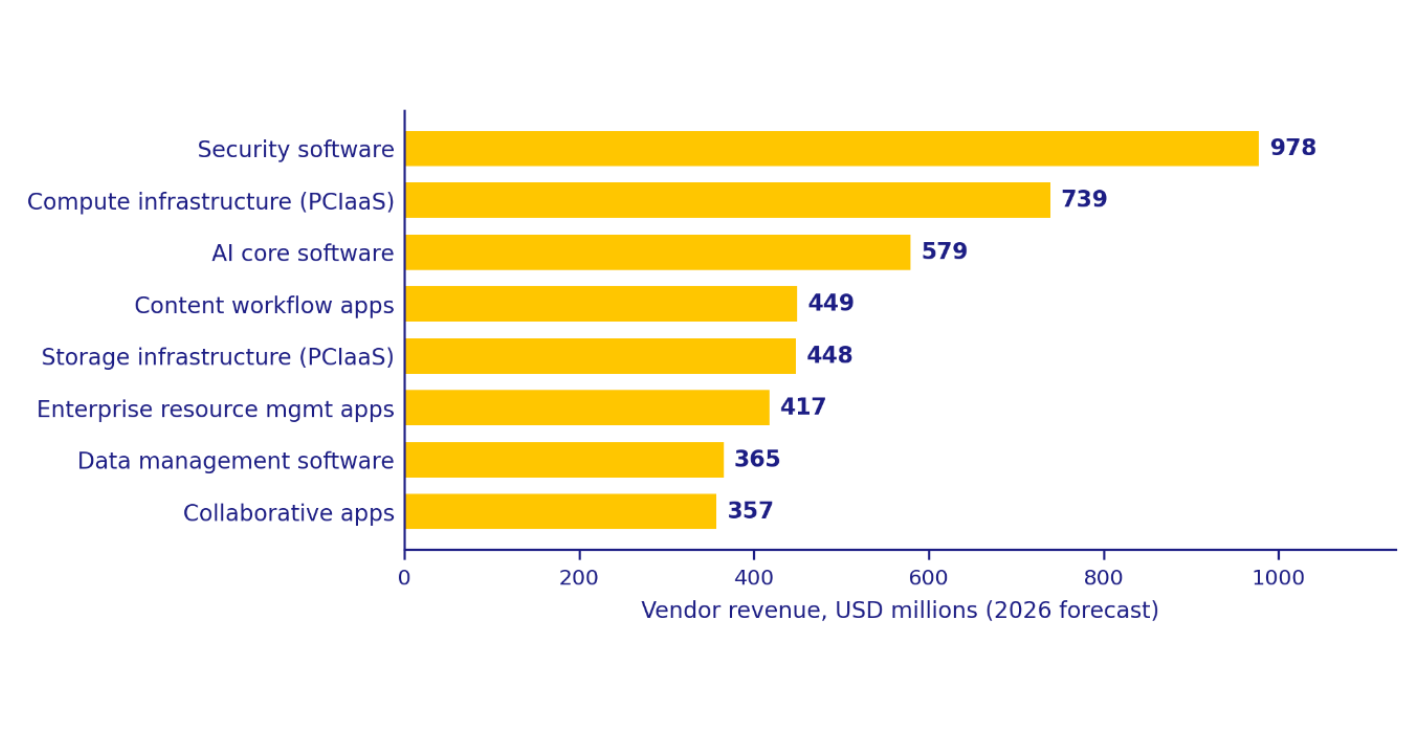
IDC’s 2025Q4 forecast puts Saudi Arabia’s public cloud services revenue at $5.85 billion in2026. Security software ($978 million), compute infrastructure ($739 million) and AI core software ($579 million) are the three largest segments.​

​Business applications and data management also rank in the top eight, showing that spend extends beyond infrastructure to the workload’s organizations are modernizing.​

Discussion Themes

Sequencing Migration and Modernization​

How to decide which workloads to rehost, refactor or retain, and in what order. Where leaders balance the speed of migration against the risk of moving applications unchanged.​

Hybrid Operations, Security and Skills​

How to decide where each workload runs as data protection rules shape placement, and how to keep security and compliance consistent across environments. Where skills gaps, partners and managed services fit.​

Cost, Performance and Visibility​

How to keep cloud costs predictable and application performance visible during and after migration, including as AI raises cloud budgets. Which measures show that modernization delivers results.​

AI observability​

How to see, trace and trust AI-enabled applications and the cloud estates they run on, from performance and cost to model behavior. What leaders need to monitor as cloud AI budgets rise.​

Your host

Jebin George

Jebin George

Senior Research Manager, Cloud and Datacenter Services

IDC

Read bio

Agenda

IDC, Dynatrace & AWS Roundtable

Wed, Nov 25

6:30PM

Registration & Networking

7:00PM

IDC Welcome Address & Keynote Presentation: Beyond the Move: Modernizing Cloud Estates in Saudi Arabia

Cloud in Saudi Arabia is moving from build-out to operation. The question is no longer whether to adopt cloud but how to modernize what is already there. That means deciding which applications to move or rebuild, where data protection rules place each workload, and what limits the value organizations get from cloud today.

Jebin George

Jebin George

Senior Research Manager, Cloud and Datacenter Services, IDC

7:20PM

Dynatrace Welcome Address

7:25PM

Seeing Across the Estate: AI Observability from Migration to Operation

Applications now span several clouds, and AI workloads add behavior that is harder to predict. AI observability gives teams one view of performance, dependencies and model behavior. Problems can then be traced to their cause, and workloads reach production with evidence that they are ready.

7:45PM

Sequencing the Move: Migrating and Modernising Applications with Purpose

Not every application should move in the same way. Rehosting, refactoring and retaining carry different cost, risk and speed, and the order of moves decides how quickly value arrives. Good sequencing starts from business priorities and the readiness of each workload.

8:00PM

Panel Discussion – Moving Fast Without Losing Control: Migration, Security and Skills

Speed and control pull in different directions during migration. Security and compliance must stay consistent as workloads move between environments, skills gaps slow delivery, and results still need to be measured. Peer experience shows where programs hold up and where they stall.

8:30PM

Summary & Close

The priorities that emerge across sequencing, hybrid operations, cost and performance, and AI observability, and the first actions that follow from them.

8:40PM

Dinner & Networking

Partners

Sponsored By
Venue

Jade Ballroom 1 | Mövenpick Hotel and Residences Riyadh

3478 Khair Al Din Al Zarkali Street, Al Ghadeer, Riyadh 13311

IDC AI Leadership Summit

22 Mar 2027 Riyadh, Saudi Arabia
IDC AI Leadership Summit

IDC AI Leadership Summit

Beyond AI Transformation

Reimagining Leadership, Innovation, and Value Creation in the Enterprise

22 Mar 2027 Riyadh, Saudi Arabia

The Kingdom has set its AI ambition at global scale. Now the advantage belongs to the enterprises that execute. The AI Leadership Summit & Awards 2027 gathers Saudi Arabia’s boards, CEOs, and business and technology leaders to turn a $100 billion AI agenda into board-led governance, trusted operating models, and returns that compound.​

What You'll Learn​

AI spending in Saudi Arabia is set to grow nearly fivefold by 2029. But only half of Saudi organizations consider themselves ready to take full advantage of AI. The gap between investment and impact is where leaders need a framework. The AI Leadership Summit is built for the executives closing that gap. What you will take away:​

  • A governance model for AI that works across the C-suite​
  • How to move from AI pilots to enterprise-scale value in Saudi’s key sectors.​
  • The talent and operating model decisions that determine whether AI compounds or stalls.​
  • An honest read on agentic AI: where Saudi enterprises are leading, and where the risks are real.​

Key Themes​

Board-Led AI Strategies

Defining enterprise direction, investment priorities and competitive advantage in the AI era.

Innovation vs Productivity

Balancing new revenue creation with substantial revenue-per-employee gains.

Organizational Transformation in the AI Era

Transforming organizational models for human + AI collaboration.

The Autonomous Enterprise

Moving from AI-assisted processes to autonomous, agent-driven enterprise operations

Enterprise Architecture for the AI Era

Evolving the tech stack with a guiding business architecture.

AI-Enabled Operating Models

Redesigning workflows, decision-making and execution for the AI era.

Trust at Enterprise Scale

Building scalable governance, oversight and transparency into enterprise AI systems.

Measuring AI ROI at Enterprise Scale 

Reshaping how productivity is measured across every Line of Business.

Speakers

Melih Murat

Melih Murat

Associate Research Director, Artificial Intelligence (META)

IDC

Read bio

Why Attend

Set the Saudi AI Strategy

Build an investment thesis aligned to Vision 2030 and SDAIA priorities, not just global best practice.

Govern with Discipline

Navigate PDPL, CITC mandates, and SAMA regulations while maintaining the velocity Saudi enterprises need.

Quantify the Value

Move beyond pilot metrics. Translate AI investment into measurable revenue-per-employee gains across Saudi’s key sectors: energy, finance, and government.

Lead the Change

Build AI talent pipelines, Saudization-compatible operating models, and the culture to sustain an AI-Fueled Enterprise.

Knowledge Hub

What META services buyers really want from their partners in 2026​

Buyers across the META now choose partners mainly on AI and agentic AI capability, which makes delivering AI at scale the deciding factor.​

Read more

The $22.5 Trillion AI Opportunity​

IDC estimates AI will create $22.5 trillion in cumulative economic value by 2031, with agentic AI driving the next wave of spending. Organizations that move from pilots to scaled, measurable deployments will capture it.​

Read more

Venue

Mövenpick Hotel and Residences Riyadh

Opal Ballroom, Lobby Level

Be a part of it!

Register Now

IDC, Couchbase & AWS Roundtable

25 Jan 2027 Riyadh

IDC, Couchbase & AWS Roundtable

Smart Government, Smarter Spend

25 Jan 2027 Riyadh

Hosted By

Logo Logo

Driving Vision 2030 with AI Innovation and Consolidation

As Saudi Arabia accelerates its Vision 2030 digital government transformation, public sector leaders face a dual challenge: delivering AI-powered citizen services while strictly managing IT budgets and infrastructure overhead.

​

IDC projects that AI spending in Saudi Arabia will grow to USD 7.83 billion by 2029, a 30.3% CAGR, yet only half of Saudi organizations consider themselves well-prepared for AI, with data foundations, skills gaps, and governance cited as the top barriers.

​

Achieving the balance Vision 2030 demands requires shifting away from fragmented legacy databases toward consolidated, modern architectures. IDC’s own regional research names fragmented data estates as the most cited hurdle to production-grade AI in the Middle East.

​

Join senior public sector leaders for an exclusive executive roundtable exploring how government entities can optimize total cost of ownership and modernize data infrastructure.

​

The discussion will cover strategic approaches to consolidating database stacks, making the most of cloud infrastructure, and applying modern AI-ready data platforms to drive operational efficiency, reduce data sprawl, and deliver scalable AI initiatives cost-effectively.​

Discussion Areas

The Price of AI Ambition

IDC projects Saudi Arabia’s AI spending will nearly triple by 2029, and every additional workload adds another data source that has to be secured, synced, and paid for unless agencies consolidate first.

Rethinking TCO for AI Projects

Fragmented legacy databases inflate licensing, integration, and maintenance costs long before a new AI project ever launches. Learn why government leaders treat total cost of ownership as a starting requirement for any new citizen service.

Fewer Systems, Faster Citizen Services

Every additional database stack run by an agency adds a step between a citizen’s request and the answer. Explore why consolidating onto a smaller number of modern, cloud-ready platforms is critical.

Governance that Scales with the Workload

Saudi data residency and sovereignty requirements do not pause while agencies modernize. The leaders furthest along build for governance and compliance requirements while cutting infrastructure overhead, rather than treating the two as separate projects.​

Agenda

IDC, Couchbase & AWS Roundtable

Tue, Nov 10

6:30PM

Registration & Networking

7:00PM

Welcome Address

7:05PM

IDC Keynote: Vision 2030’s Spending Math

IDC presents current research on META public sector AI and digital transformation spending.

Melih Murat

Melih Murat

Associate Research Director, Artificial Intelligence (META), IDC

7:25PM

Couchbase Session: Unifying Fragmented Data with the AI Data Plane to Cut TCO and Data Sprawl​

As organisations navigate increasingly complex data environments, fragmented data and siloed systems can drive up costs, create inefficiencies, and limit AI readiness. This session will explore how an AI Data Plane can unify disparate data sources, simplify data management, and reduce data sprawl. Discover how Couchbase helps organisations optimise their data architecture, lower Total Cost of Ownership (TCO), and build a scalable foundation for AI-driven innovation.

Ettore Cremonesi

Ettore Cremonesi

Senior Director, Solutions Engineering EMEA, Couchbase

7:45PM

AWS Session: Building Cost-Efficient Government Cloud Infrastructure for AI at Scale​

As governments accelerate AI adoption, building scalable and cost-efficient cloud infrastructure is essential to support growing workloads while maintaining security, compliance, and operational efficiency. This session will explore how AWS enables government organisations to modernise their cloud infrastructure, optimise costs, and scale AI capabilities securely. Discover practical strategies for building a resilient, future-ready cloud foundation that can support AI innovation at scale.

8:05PM

Networking Break

8:15PM

Panel Discussion: From AI Ambition to AI Outcomes

A senior public sector panel on closing Saudi Arabia’s AI readiness gap: the budget, governance, and data decisions standing between Vision 2030’s AI ambition and outcomes leaders can tangibly measure.​

Melih Murat

Melih Murat

Associate Research Director, Artificial Intelligence (META), IDC

Ettore Cremonesi

Ettore Cremonesi

Senior Director, Solutions Engineering EMEA, Couchbase

8:45PM

Closing Note

8:55PM

Dinner & Networking

Speakers

Melih Murat

Melih Murat

Associate Research Director, Artificial Intelligence (META)

IDC

Read bio

Ettore Cremonesi

Ettore Cremonesi

Senior Director, Solutions Engineering EMEA

Couchbase

Read bio

Partners

Hosted By

Venue

Fairmont Riyadh

Mecca Meeting Room

Area, Business Gate, Qurtubah

Riyadh 11552

Be Part of it!

Register Now

Knowledge Hub / Cloud4c

Partner Spotlight

Cloud4c

Partner Spotlight

The ABCDE of the Agentic Enterprise: Intelligence Starts, Scales, or Stalls with the Core

Enterprise AI is crossing an important threshold. Intelligence that once sat alongside employees is beginning to enter the operating fabric of the enterprise: observing events, invoking applications, coordinating workflows, resolving incidents, and increasingly making decisions and taking autonomous action at unprecedented speed and scale.

This changes the modernization equation. An AI assistant can work around fragmented foundations. An autonomous agent cannot. As agentic exposure increases, every weakness in the enterprise core, from disconnected applications and unreliable data to excessive permissions and poor observability, can directly affect an automated outcome.

This places a new agentic AI-focused readiness and modernization imperative around five mission-critical dimensions, the pillars to an enterprise operating ecosystem: Applications, Business Outcomes, Compute, Data, and Embedded Security. This now defines the operating core of the agentic enterprise.

Applications can no longer remain operating in fragmented systems connected through manual hand-offs. Agentic operations require API-first architectures, integration fabrics, observability, standardized runbooks and orchestration so intelligence can move securely across processes. Business outcomes must determine where autonomy is valuable and where human judgment must remain in control.

Compute decisions also become more nuanced. The most capable AI model is not necessarily the right model for every task. Performance, latency, context, sovereignty and economics will increasingly drive dynamic model and workload placement. This creates a new Agent FinOps discipline: continuously matching business processes to the models and infrastructure that deliver the required outcome at an appropriate cost and risk profile.

Data must similarly become actionable and agent-ready, not merely available. Agents require unified enterprise data foundations with trusted context, governed retrieval, lineage and policy-aware access before information enters prompts, RAG pipelines or automated decisions.

This is giving rise to another layer of enterprise intelligence architecture: AI Studios and agent factories that industrialize how agents are built, tested, deployed and continuously evaluated, supported by an agentic control plane governing identities, model routing, permissions, tool access, consumption, observability and auditability.

Embedded security becomes fundamental because autonomy increases the consequence of misplaced trust. Zero Trust, non-human identity governance, continuous exposure management and policy-gated remediation must secure not only infrastructure, but the very actions agents are authorized to perform.

For Saudi Arabia’s Vision 2030 ambitions, the implication is significant: scaling intelligence across critical and regulated sectors will require sovereignty, resilience and governance to advance at the same pace as autonomy.

The agentic enterprise will not be defined by how many agents it deploys, but by how confidently its core can allow them to act and deliver impact in sync.

IDC & NTT DATA AWS Roundtable

29 Mar 2027 Fairmont Riyadh

IDC & NTT DATA AWS Roundtable

Ambition, Engineered: Cloud Strategy for Saudi Arabia's AI Roadmap

29 Mar 2027 Fairmont Riyadh

Hosted By

Logo

Saudi enterprises are setting ambitious AI goals: faster innovation, enterprise-wide scale, and stronger
governance over how AI gets used. IDC’s research across the Middle East shows that 43% of organizations say pursuing those goals has directly accelerated their move to cloud, and 24% have already rewritten their cloud strategy specifically to keep pace with AI.


IDC and NTT DATA are hosting a roundtable for CIOs in Riyadh on October 12, centered on the same question IDC posed to enterprises across the region: what really determines the progress and success of an enterprise’s AI strategy?


IDC’s own research points CIOs toward the decisions that actually determine that: where will AI run, can the infrastructure support it, is it resilient and compliant, can it operate at scale, and can the organization afford it sustainably. Join us as we unpack some of the most critical decisions that define the AI roadmap for Saudi enterprises.

Key Discussion Areas

The Infra Behind the AI Ambition

AI ambition is setting the pace for cloud decisions right now. For Saudi enterprises, that
means the cloud strategy gets built around what AI needs, not the other way around.

Modernization Aimed at AI

Legacy applications are the quiet blocker on most AI roadmaps. Many enterprises hold onto them to avoid disrupting the business, but an AI roadmap that’s serious about scale has to deal with modernization first.

Sovereign Architecture

Sovereignty isn’t a policy checkbox anymore. It’s a design decision built into the cloud architecture from the start, especially as geopolitics increasingly shapes where data and workloads can sit.

AI and Cloud Cost Control Equation

Getting the AI right also means getting disciplined about which parts of cloud actually deserve the investment.

Agenda

IDC & NTT DATA AWS Roundtable

Mon, Oct 12

6:30PM

Registration & Networking

7:00PM

IDC Keynote: From Ambition to Scale: The CIO Playbook for Saudi Arabia’s AI Roadmap

Saudi AI roadmaps are ambitious; scaling them is a challenge. Drawing on IDC research, this keynote maps the gap between ambition and production, and the five cloud decisions that close it: where AI runs, what infrastructure it needs, how sovereignty and resilience are designed in, how it operates at scale, and how its cost stays under control.

Jebin George

Jebin George

Senior Research Manager, Cloud and Datacenter Services, IDC

7:15PM

AI Ambition Meets Production Reality

As Saudi enterprises move AI from ambition to production, the cloud strategy gets built around what AI needs. This session unpacks the decisions that make that real in the Kingdom – where AI runs, how sovereignty and resilience are designed in, and the foundation that turns infrastructure into AI-ready capability.

Faisal Banaeamah

Faisal Banaeamah

Senior Partner Solutions Architect, MENAT, AWS

7:30PM

The End of the Cloud Migration Project: Why Moving to the Cloud Is Just the Beginning

What happens after an organization successfully migrates its workloads to the cloud? This session challenges the traditional definition of cloud success and explores why migration should be viewed as the starting point rather than the destination. Through practical scenarios, we will examine how organizations can move from migration to modernization, data-driven applications, generative AI, and agentic workloads. Attendees will learn how to rethink their cloud journey, identify opportunities beyond infrastructure migration, and connect cloud foundations to measurable business transformation.

Mahmoud Elzayyat

Mahmoud Elzayyat

Sales Manager, NTT DATA

Bassel Al Annan

Bassel Al Annan

Pre-Sales Manager, NTT DATA

7:45PM

Open Discussion: Why AI on Cloud, Why Now: What’s Compelling Saudi CIOs to Decide

Saudi CIOs are past asking whether to move to AI on cloud-  sovereignty rules, national AI ambitions, and rising competitive pressure have made this a board-level decision. This session pairs IDC’s market perspective with NTT DATA’s delivery perspective to unpack what’s really driving the call.

Jebin George

Jebin George

Senior Research Manager, Cloud and Datacenter Services, IDC

Mahmoud Elzayyat

Mahmoud Elzayyat

Sales Manager, NTT DATA

Bassel Al Annan

Bassel Al Annan

Pre-Sales Manager, NTT DATA

Faisal Banaeamah

Faisal Banaeamah

Senior Partner Solutions Architect, MENAT, AWS

8:40PM

Summary & Closing Remarks

8:45PM

Dinner & Networking

Speakers

Jebin George

Jebin George

Senior Research Manager, Cloud and Datacenter Services

IDC

Read bio

Mahmoud Elzayyat

Mahmoud Elzayyat

Sales Manager

NTT DATA

Read bio

Bassel Al Annan

Bassel Al Annan

Pre-Sales Manager

NTT DATA

Read bio

Faisal Banaeamah

Faisal Banaeamah

Senior Partner Solutions Architect, MENAT

AWS

Read bio

Partner

Venue

Fairmont Riyadh

Mecca Meeting Room

Be Part of it!

Register Now

IDC & Zoom Roundtable

25 Jan 2027 Fairmont Riyadh

IDC & Zoom Roundtable

When the Meeting Ends: Redefining Virtual Experience for the AI Era

25 Jan 2027 Fairmont Riyadh

Hosted By

Logo

Your communication platform is no longer just where conversations happen. It’s becoming the intelligent
execution engine where work gets done, actions get triggered, and increasingly, customer and user experience are shaped. AI is what’s making this possible, moving from assistive to autonomous, now able to execute multistep work rather than just summarize or assist.


By 2027, IDC expects 60% of organizations to manage multiagent experiences that span multiple channels, applications, and suppliers, enabling more seamless and context-rich experiences.


IDC and Zoom are hosting an exclusive roundtable for senior IT decision makers in Saudi Arabia to understand what this shift demands of your organization: how your platform strategy, customer experience approach, and governance decisions need to evolve as AI takes on more of the work.


These sessions focus on delivering a clearer view of the decisions ahead, grounded in IDC research, and the chance to compare notes directly with peers already navigating the same shift.

Key Discussion Areas

What Your Platform Should Actually Be Doing For You

Communication platforms are moving past hosting meetings and messages. They’re becoming the layer that triggers work and drives outcomes, and that changes what you should expect from yours.

How Ready You Are For Autonomous AI

AI is moving from assisting work to executing it. Get a clear read on where your organization stands today, and what preparing for that shift actually involves.

Where Automation Should Meet CX

The platforms pulling ahead are the ones connecting internal automation directly to customer experience, not treating the two as separate investments. See what that integration looks like in practice.

Trust, Industry Fit, And Interoperability, Together

As platforms take on more autonomous action, governance and security become as important as capability. The same goes for industry fit: the strongest platforms pair vertical-specific workflows with real interoperability across your stack, not a trade-off between the two.

Agenda

IDC & Zoom Roundtable

Mon, Sep 28

6:30PM

Registration & Networking

7:00PM

IDC Keynote: Preparing for the Agent Economy: Acceleration, Orchestration and Resiliency

We have moved past the “Great Implementation.” As we enter 2026, the global enterprise has reached a critical inflection point where the sheer volume of data, the complexity of multi-cloud ecosystems, and the velocity of agentic AI have outpaced traditional human management. The mandate for the IT executives has fundamentally shifted: it is no longer about managing technology, but about architecting autonomy.

Eren Eser

Eren Eser

Associate Research Director, Türkiye, IDC

7:20PM

AI as the Engine, Not the Assistant

AI used to play a supporting role- drafting, summarizing, answering on the side. That’s changing. Leading enterprises are moving AI from the sidelines to the center, powering core workflows instead of assisting around their edges. This keynote explores where the opportunity is moving, and what it takes to help enterprises move from experimenting with AI to running on it.

Mohannad Al Kalash

Mohannad Al Kalash

Vice President of Zoom for the Middle East, Türkiye, Africa and Pakistan (METAP), Zoom

7:45PM

Panel Discussion: When the Meeting Ends: Redefining Virtual Experience for the AI Era

AI is transforming meetings from bounded events into continuous, intelligent workflows- capturing decisions, driving follow-ups, and extending collaboration long after the call ends. This panel explores what virtual experience means in an AI-first world: balancing automation with human connection, rethinking meeting culture, and preparing teams for a future where “the meeting” is just one touchpoint in an ongoing, AI-augmented process.

Eren Eser

Eren Eser

Associate Research Director, Türkiye, IDC

Mohannad Al Kalash

Mohannad Al Kalash

Vice President of Zoom for the Middle East, Türkiye, Africa and Pakistan (METAP), Zoom

Wael Almarzouki

Wael Almarzouki

General Manager for Saudi Arabia and Bahrain, Zoom

8:25PM

Summary & Closing

8:30PM

Dinner & Networking

Speakers

Eren Eser

Eren Eser

Associate Research Director, Türkiye

IDC

Read bio

Mohannad Al Kalash

Mohannad Al Kalash

Vice President of Zoom for the Middle East, Türkiye, Africa and Pakistan (METAP)

Zoom

Read bio

Wael Almarzouki

Wael Almarzouki

General Manager for Saudi Arabia and Bahrain

Zoom

Read bio

Partner

Venue

Fairmont Riyadh

Dammam Meeting Room

Be Part of it!

Register Now

IDC & Iron Mountain Roundtable

24 Jan 2027 Fairmont Riyadh

IDC & Iron Mountain Roundtable

Data First: Why Agentic AI Success Starts With Your Data

24 Jan 2027 Fairmont Riyadh

Hosted By

Logo

Saudi organizations are moving fast on agentic AI. IDC forecasts that total AI buyer spending in the Kingdom will grow from $2.72 billion in 2025 to $7.83 billion in 2029, a 30.3% CAGR. Yet only half of Saudi organizations consider themselves ready to make the most of that investment, and a quarter cite a non-centralized data foundation as one of their biggest barriers.


According to IDC, companies that don’t prioritize high-quality, AI-ready data will experience a 15% loss in productivity by 2027 as they try to scale generative and agentic AI. The spending is real. The readiness to use it well is not, at least not yet.


IDC and Iron Mountain bring Saudi CIOs together for a roundtable in Riyadh to explore what it takes to make enterprise data agent-ready: clean, classified, and accessible enough for an AI agent to act on with confidence.


The conversation will center on where CIOs should draw the line between data that’s ready for autonomous action and data that still needs work –  including how to identify hidden or disconnected data that may not yet be visible to the organization or integrated into its systems -and how that decision should shape the next two years of investment.

Key Discussion Areas

Find the dark data hiding in your organization

How leading CIOs are locating unstructured and disconnected data that sits outside core systems. Why this hidden data is often the biggest blind spot in an AI-ready data strategy.

The classification bottleneck​

How CIOs are deciding which data sets can be trusted to an AI agent today, and which ones still need classification and cleanup.

Build the case for data readiness as a productivity issue

IDC forecasts a 15% productivity loss by 2027 for organizations that don’t prioritize AI-ready data. How leaders are using this risk to secure internal buy-in for data foundation work.

Manage compliance risk as data opens up to agents

How CIOs are extending classification and retention policy to cover data that agents can now act on.

Agenda

IDC & Iron Mountain Roundtable

Sun, Sep 27

6:30PM

Registration & Networking

7:00PM

IDC Keynote: Preparing for the Agent Economy: Acceleration, Orchestration and Resiliency

We have moved past the “Great Implementation.” As we enter 2026, the global enterprise has reached a critical inflection point where the sheer volume of data, the complexity of multi-cloud ecosystems, and the velocity of agentic AI have outpaced traditional human management. The mandate for the IT executives has fundamentally shifted: it is no longer about managing technology, but about architecting autonomy.

Eren Eser

Eren Eser

Associate Research Director, Türkiye, IDC

7:20PM

From Dark Data To An Agent-Ready Foundation

Enterprises are sitting on vast stores of dark, unclassified data that AI agents can’t yet trust or use. This keynote shows how to turn that hidden liability into a governed, agent-ready foundation- covering the classification, metadata, and lifecycle practices needed to get there, drawn from Iron Mountain’s experience managing information at scale.

Mihails Balonuskovs

Mihails Balonuskovs

Regional Digital Solution Architect (MENAT), Iron Mountain

7:40PM

Open Discussion: Closing the Gap Between AI Ambition and AI-Ready Data

AI ambition is outpacing the data foundations needed to support it. This panel unpacks why so many AI initiatives stall at the data layer – fragmented ownership, weak governance, poor quality – and debates what “AI-ready” really means, with practical steps for closing the gap.

Eren Eser

Eren Eser

Associate Research Director, Türkiye, IDC

Mihails Balonuskovs

Mihails Balonuskovs

Regional Digital Solution Architect (MENAT), Iron Mountain

8:25PM

Summary & Closing Remarks

8:30PM

Dinner & Networking

Speakers

Eren Eser

Eren Eser

Associate Research Director, Türkiye

IDC

Read bio

Mihails Balonuskovs

Mihails Balonuskovs

Regional Digital Solution Architect (MENAT)

Iron Mountain

Read bio

Partner

Venue

Fairmont Riyadh

Taif Meeting Room

Be Part of it!

Register Now

Knowledge Hub/Walid Gomaa

Partner Spotlight

Walid Gomaa
Chief Executive Officer
Omnix International

Partner Spotlight

Saudi Arabia’s Agentic AI Leap: Turning Vision 2030 into Intelligent Action

As Vision 2030 enters its final phase, Saudi Arabia stands at a defining moment in its digital transformation. With the world’s attention already turning toward mega-events such as the FIFA World Cup 2034 and Expo 2030 in Riyadh, the Kingdom has added momentum to its drive to build AI, data and automation capabilities at national scale.

That drive is backed by real money. With  AI investment reported at $100 billion, Saudi Arabia has moved to become among the global leader in AI and data-driven innovation. Their AI  spending is projected to reach $7.43 billion by 2029, growing at roughly 54% annually.

Agentic AI can bring about a paradigm shift in this transition, particularly in the public sector. Where the initial phase of automation focused largely on digitizing existing processes, agentic AI goes further: it enables systems to plan, decide and act, helping reshape citizen services and public programs.

SDAIA, Saudi Arabia’s national authority for data and AI, is already helping establish the foundations for responsible AI adoption. As agentic systems grow more capable, clear standards for procurement, deployment and governance will be essential to ensure innovation supports the Kingdom’s goals around data security and digital sovereignty.

The opportunity for the private sector is equally large. CIOs across banking, energy, healthcare and logistics are working to modernize legacy IT systems, close data gaps and secure AI talent, all while turning early pilots into scalable results. Continued investment in digital infrastructure, sovereign cloud capabilities and stronger public-private partnerships will make this possible.

Cybersecurity has a critical role in all of this. Agentic AI while processing data can act against security and can compromise systems.  Saudi Arabia’s National Cybersecurity Authority (NCA) is already responding to this shift. In July 2026, the NCA opened a public consultation on its new AI Cybersecurity Guidelines, it covers emerging technologies including generative and agentic AI. The guidelines focus on four areas: cybersecurity governance, cybersecurity defense, cybersecurity resilience and third-party cybersecurity.

Saudi Arabia’s opportunity is therefore bigger than simply adopting the latest AI models. The real advantage will come from building the infrastructure skills and governance needed to put agentic AI to work responsibly and at scale. That is what will turn the Kingdom’s AI ambition into lasting operational reality.

Knowledge Hub / Georgy Ovanesyan

Partner Spotlight

Georgy Ovanesyan
Chief Executive Officer
Axidian

Partner Spotlight

The Service Account Did It – Three Questions Your AI Agent Must Answer

An AI agent updates a supplier’s payment details. Later, someone asks what happened. The business application has one answer: a service account made the change.

That is not an answer. It does not say who requested it, which agent interpreted the instruction, or whether the action stayed inside its approved authority.

Most organizations cannot say how many AI agents have access to their systems. Every one of them can act.

Saudi Arabia has already set out what good looks like. In July 2026 the National Cybersecurity Authority opened its draft AI Cybersecurity Guidelines (AICG-1:2026) for public consultation — four domains, fifteen subdomains and forty-two guidelines covering generative and agentic AI. They are recommended practice rather than mandatory controls, but NCA advises every entity adopting AI to apply them.

Preparing does not require a new compliance programme. Three questions cover most of it.

Who is acting?
Every agent needs an identifiable owner and a defined purpose, and its actions must connect back to the person or approved process that initiated them. AICG asks for an inventory of all AI system components with defined owners and lifecycle status (2-1-1, 2-1-2), and for agent actions to be classified by impact, likelihood and reversibility (1-1-2).

What is it allowed to do?
An agent reaches corporate systems through service accounts, API tokens or other machine credentials. AICG asks for role-based permissions defined explicitly for human users, service accounts and AI agents alike, under least privilege and segregation of duties (2-2-1), and for periodic review of the identities, access rights, tokens and service accounts those systems use (2-2-2).

What did it do?
The organization must be able to reconstruct which systems, data and tools the agent reached, what it did and what resulted. AICG asks for logging of authentication and access events, privileged actions, data access, prompt configuration changes and tool invocations (2-8-1), and of AI-initiated actions affecting confidentiality, integrity or availability (2-8-2).

Together these create a traceable chain connecting identity, permission and action — and make graduated autonomy under continuous human oversight (1-2-7) enforceable rather than aspirational.

Start now. Take one high-impact agent and trace a single action from instruction to outcome.

Can you name the initiator, the agent, the credential, the permissions it used and the result it produced?

If the only answer is a service account, the work starts there.

Knowledge Hub / Dr Mazen Abduljabbar

Partner Spotlight

Dr. Mazen Abduljabbar
Country Manager – KSA
Commvault

Partner Spotlight

AI is forcing organizations to rethink resilience

Nearly four years into the GenAI revolution, many organizations have decisively moved from experimentation to operational deployment. Another sign of this market maturity is the growing emphasis on governance, ethics, security controls, and regulatory compliance, illustrated by the arrival of formalized rules.

But as is becoming increasingly clear, implementing AI is one thing; almost anyone can do that. Implementing it correctly, with the proper safeguards in place, is something else entirely, and there are some major risks to address. As was inevitable, more and more stories are emerging about what happens when organizations rely on AI outputs that later prove to be extremely damaging.

The role of ResOps

When it comes to resilience, there is now a very important question: how can organizations committed to AI define and apply a version of resilience that is fit for purpose?

Firstly, it’s important to recognize that resilience models would typically treat security and recovery as separate functions. This approach was (and still is) effective when incidents can be contained, and organizations have the time to investigate what has happened.

Identifying a problem is only part of the challenge. Organizations also need to understand where affected data has traveled and what else depends on it. Visibility into the various AI and data dependencies is becoming as important as recovery itself, because restoring systems is much harder when organizations cannot immediately determine what has been affected, unless significant.

As a result, the nature of resilience needs to change. It’s no longer good enough for it to lean towards the reactive; it needs to operate as a continuous operational discipline. In a nutshell, that is the basis for ResOps (Resilience Operations), in which data security is more closely integrated with recovery to maintain trust in operational environments over time. Recovery remains important, but it becomes part of a broader resilience process that continuously discovers, protects, monitors, and restores trusted data.

Through a ‘Resilient Operations’ approach, teams can quickly determine what has been affected and which AI workloads depend on the compromised data. The objective is not simply to recover systems but to ensure that AI continues to operate on trusted data. Given that, in many ways, AI has changed the nature of risk, resilience must follow suit if we are to avoid a situation where breaches and serious errors are to remain the exception rather than becoming the rule.