Knowledge Hub / Abdullah Smadi

Partner Spotlight

Abdullah Smadi
General Manager, DSM & AI
Magnoos

Partner Spotlight

From Reactive to Autonomous: Why Critical Business Orchestration Are the CIO’s Most Urgent Agenda Items

Across the Middle East, enterprises are making bold, capital-intensive commitments to artificial intelligence. Budgets have been approved, pilots have been launched, and boardroom conversations have shifted decisively toward AI-driven transformation. According to IDC, AI is expected to contribute $19.9 trillion to the global economy through 2030, driving 3.5% of global GDP, and every dollar spent on AI solutions is projected to generate $4.60 in economic impact through indirect and induced effects.¹ It is little surprise, then, that IDC research shows 89% of worldwide IT leaders are prioritizing AI-led initiatives within stable or increased budgets.²

Yet for many organizations, the anticipated financial and operational return on investment (ROI) remains frustratingly out of reach. This is not a failure of AI strategy or technological capability. It is a failure of Critical Business Orchestration.

When AI investments fail to deliver enterprise value, it is almost always because the underlying operational ecosystem cannot support them. For years, application workflows, data pipelines, and infrastructure management functioned in isolated technical silos. Disconnected automation tools ran independently, leaving enterprise operations fundamentally reactive. This fragmented model is no longer just an IT inefficiency; it is a profound business risk. When AI generates decisions, predictions, and actions at machine speed, an enterprise cannot afford to rely on disconnected, legacy operational layers to execute them.

IDC’s TechBrief on AI Operations (December 2025) highlights this exact challenge: AIOps is shifting away from traditional signal intelligence toward outcome-driven, agent-oriented architectures, and success hinges entirely on organizational readiness to embrace automation at scale.³ Furthermore, IDC has identified this lack of operational readiness as a primary barrier preventing enterprises from fully realizing their AI investments.⁴

Today’s CIO operates under a high-stakes dual mandate: they must aggressively drive enterprise-wide intelligence while ensuring the critical services powering the business run with absolute continuity and zero tolerance for disruption. Balancing these mandates requires a fundamental shift to an application and data workflow orchestration platform built for the modern enterprise.

As IDC’s 2026 MarketScape on AIOps states, the discipline is “not about automation” alone; it demands “a radical rethinking of operations, empowering teams to create outcome-driven, collaborative decision-making.”⁵

The modern CIO’s most urgent priority is not the acquisition of the next isolated AI tool or LLM. It is the architecting of an intelligent, resilient operational backbone capable of orchestrating complex business processes autonomously. Control-M provides that very backbone—and it is the only way to ensure your enterprise’s AI investments compound in value rather than collapsing under their own operational weight.

The window for building this orchestration layer is closing faster than most leadership teams realize.

References

  1. IDC Press Release — AI Spending in META, Jan 2025 — my.idc.com/getdoc.jsp?containerId=prMETA53088825 | Source: IDC Worldwide AI and Generative AI Spending Guide (V2, August 2024). Contains the $19.9T / 3.5% GDP / $4.60 multiplier figures and the 89% IT leaders statistic.
  2. IDC Press Release — AI Spending in META, Jan 2025 — my.idc.com/getdoc.jsp?containerId=prMETA53088825 | Source: IDC Worldwide AI and Generative AI Spending Guide (V2, August 2024). The 89% IT leaders budget statistic is cited directly from Crawford Del Prete, IDC Global President.
  3. IDC TechBrief: AI Operations (AIOps), Doc #US53955125, Dec 2025 — my.idc.com/getdoc.jsp?containerId=US53955125 | By Shannon Kalvar, Research Director, Enterprise Systems Management, Observability and AIOps, IDC.

  4. IDC White Paper — The Impact of AI Workloads on Networks and Their Operations, Nov 2025 — ibm.com/new/product-blog/new-idc-report-how-ai-is-reshaping-enterprise-networks | IDC white paper sponsored by IBM Technology Lifecycle Services, November 2025. IDC identifies operational readiness as a primary barrier to AI adoption.
  5. IDC MarketScape: Worldwide AIOps 2026 Vendor Assessment, Doc #US54116226, Mar 2026 — my.idc.com/getdoc.jsp?containerId=US54116226 | By Shannon Kalvar, Research Director, Enterprise Systems Management, Observability and AIOps, IDC.


UAE CIO Xchange / Proceedings

UAE CIO Xchange / Proceedings

Protected

To access this content, please enter the password you have received from IDC.


Knowledge Hub / Faisal Ameer Malik

Partner Spotlight

Faisal Ameer Malik
Chief Technology Officer
Huawei Enterprise Business Group, Middle East

Partner Spotlight

Navigating the AI Realm with Huawei: Staying Focused on What Truly Counts

For the past several years, we have all been watching enterprises pour significant capital into AI infrastructure, whether it is data centers, compute clusters and sophisticated models. The ambition is real, and in many cases, so is the investment. Having worked at the intersection of technology and enterprise strategy for Huawei in this region, I find myself returning to one question: Are we building AI that actually works for the people and industries it is meant to serve?

Across the Middle East and Central Asia, AI infrastructure investment is accelerating, and that momentum is welcome. But investment in infrastructure is not the same as investment in outcomes. A data center optimized for high-density compute means little if the enterprise running it cannot point to a single workflow that has meaningfully improved. The risk is that we measure our progress in petaflops and parameter counts, while the harder question whether any of this is creating real value remains unasked.

Deploying AI for your enterprise means building a complete, integrated system, one that brings together compute, data, and model capability in service of a specific outcome. Consider what that looks like in practice: a teacher in a remote classroom gaining access to personalized educational tools; a doctor leveraging predictive diagnostics to save lives; a researcher accelerating the discovery of new materials or medicines. These scenarios represent the true standard against which every infrastructure decision should be measured.

The Huawei and Redington partnership holds a unique position in the AI ecosystem. What distinguishes our approach is that we address every layer of the stack and integrate them. Starting with Data Center Infrastructure: facility design, power architecture, precision cooling, and physical security, built for high-density AI workloads with energy efficiency at the core. At the compute layer, our Atlas 850E Server and Atlas 950 SuperPoD Cluster deliver the performance enterprises need for large-scale model training and real-time inference. Our AI-optimized storage layer eliminates the I/O bottlenecks that silently throttle AI performance in most deployments, a problem enterprise rarely diagnoses until it is costing them significantly. At the model and platform layer, we support over 30 plus foundation models natively, including DeepSeek, GPT, Llama, and GLM etc., with one-stop model deployment, management and migration tools. And at the application layer, we co-develop industry-specific and scenario-specific models with partners across finance, telecommunications, education, health, energy, and government. This is where the architecture earns its value and the question “What should AI do” receives a concrete answer.

A robust AI ecosystem is what converts infrastructure capability into industry outcomes, and that requires openness by design. Huawei’s reference architecture for intelligent transformation is built on the principles of openness, agility, and trustworthiness. It is why our ecosystem today includes over 1,200 partners — among them more than 30 hardware partners, alongside 1.8 million developers, and more than 2,500 industry-specific AI solutions. We are continuously deepening partnerships to ensure our customers develop their own industry-specific and scenario-based models, accelerating their path to measurable operational outcomes.

The Middle East and Central Asia region is building and setting its own terms for how intelligent AI transformation should work. My ask of every enterprise and technology leader is to hold the infrastructure accountable to the outcome. At Huawei, that is the standard we set for ourselves and the partnership we offer to the region.

Proceedings

Proceedings

Protected

To access this content, please enter the password you have received from IDC.


IDC Mauritius Advisory Council 2025

IDC Mauritius Advisory Council 2026

Abdool Kadell

Abdool Kadell

Group CIO

Sun Life

Read bio

Ajmal Abdool​

Ajmal Abdool​

Group Chief Innovation Officer

RHT Holding

Read bio

Rishi Sewnundun

Rishi Sewnundun

Group CIO

MUA Group

Read bio

Sudheer Prabhu

Sudheer Prabhu

CTO

CIM Group

Read bio

Roshan Koonja

Roshan Koonja

Group Chief Information & External Affairs Officer

Constance Hospitality Management Ltd.

Read bio

David Sew

David Sew

Group Head of Technology & Digital Transformation

Medine Group

Read bio

Roopesh Mohabeer

Roopesh Mohabeer

Chief Information Security Officer (CISO) & Data Protection Officer (DPO)

Warwyck Private Bank Ltd

Read bio

Teswaree Heerah

Teswaree Heerah

Chief Data Management and Security Officer

Mauritius Telecom

Read bio

Knowledge Hub

Knowledge Hub

Discover thought-provoking articles from IDC analysts, strategic partners, and end-user speakers. Explore expert viewpoints on the latest tech trends, real-world transformation stories, and forward-looking insights shaping the digital future.

AI Infrastructure: The Foundation of the Agentic Era

The world is entering a defining moment for digital infrastructure. Artificial intelligence has moved from experimentation to ubiquity, and with it, a new operational paradigm is taking shape — one where agents rather than applications become the primary engines of digital value creation. This is the dawn of the agentic AI era, and its success depends on one thing above all else: robust, intelligent, and scalable infrastructure.

Matt Eastwood
| IDC
SVP, WW Research
Read More

Getting Your Data AI Ready

It has become a common refrain – getting data governance right is key to a successful AI strategy! This conventional wisdom is very true, but it is not a new problem. For as long as I have been involved in IT, both as an analyst and as a CIO, companies have struggled with wrangling the various data sets across the applications running at the organization.

Bob Parker
| IDC
SVP, Software and Services Research
Read More

The CIO Will Become the Orchestrator of Autonomy

South African CIOs are entering the agentic era under conditions that leave little room for experimentation without purpose. AI spending in South Africa is rising quickly, but organizational maturity remains early: IDC projects local AI-related spending to exceed $7 billion by 2030, yet more than half of South African organizations still sit in an ad hoc, experimental stage of AI maturity today. That tension matters. It means the opportunity is real, but so is the risk of fragmented investment, inflated expectations, and stalled value realization.

Jonathan Tullett
| IDC
Associate Research Director
Read More

AI Risk Is No Longer Theoretical: Governance Before the Incident, Investigation After It

Artificial Intelligence is already embedded within everyday organisational activity. Employees use it to research, analyse, summarise, draft, classify and recommend. More advanced systems can make decisions, communicate with customers, initiate transactions and undertake multi-stage activities with limited human involvement.

Neil Hare-Brown
| STORM Guidance
CEO
Read More

The future of SaaS is hazy and no one really knows what comes next

There was a time when SaaS felt predictable. You built something useful, scaled it,
and charged a subscription. If the software did well enough, growth followed. It
wasn’t easy, but it was clear. There was a sense of direction, a playbook that most
companies seemed to follow, tweak, and succeed with. Ironically enough, the same
playbook gave birth to numerous tech giants as we know them today.

Nandini Malhotra
| ManageEngine
Senior Marketing Analyst
Read More

When AI Outpaces Governance

Africa’s AI moment has arrived faster than most boardrooms expected. Pilots are becoming production systems.  Yet governance and security are often the last items on the agenda, not the first.

Karien Bornheim
| Footprint Africa Business Solutions (FABS)
CEO and Founder
Read More

Knowledge Hub / Jonathan Tullett

Analyst Spotlight

Jonathan Tullett
Associate Research Director
IDC

Analyst Spotlight

The CIO Will Become the Orchestrator of Autonomy


South African CIOs are entering the agentic era under conditions that leave little room for experimentation without purpose. AI spending in South Africa is rising quickly, but organizational maturity remains early: IDC projects local AI-related spending to exceed $7 billion by 2030, yet more than half of South African organizations still sit in an ad hoc, experimental stage of AI maturity today. That tension matters. It means the opportunity is real, but so is the risk of fragmented investment, inflated expectations, and stalled value realization.


IDC’s global research shows that 2025 launched the agentic era, but 2026 is the year enterprises started to industrialize it. A shift is underway towards systems that can reason, act, and coordinate across workflows. Yet only 45% of AI projects to date have delivered any measurable business value at all, never mind achieving their promised ROI. There is plenty of interest in AI, but the challenge is in converting AI activity into repeatable business outcomes. Executive boards should not fund AI – or any technology investment – for its own sake; they should invest in measurable outcomes.


For CIOs, the first imperative is controlled value. IDC’s research shows that fewer than 5% of CXOs currently view fully autonomous agentic AI as appealing, while 54% of C-suite leaders rank operational efficiency and productivity as the most important short-term outcomes for agentic AI. The market is not ready for grand promises about autonomous enterprises, but it is more than ready for credible progress in bounded, governed, high-value use cases. That means using agentic capabilities where they can improve speed, quality, and decision-making without creating unmanaged risk.


At a time when global markets are in turmoil and supply chains in flux, business risk tends to dictate a conservative approach to innovation, and geopolitical instability is raising the importance of sovereignty, control, and trust.


Virtually all of the South African organizations IDC has engaged with have highlighted the role of central governance in building AI roadmaps. The organizations that will move ahead are the ones that successfully impose discipline: start with strategy, prioritize use cases, map the value, model the cost, adjust for risk, and then optimize continuously. Curated pilot projects with clearer business ownership and more demanding baselines. In a constrained environment, the right roadmap is a ranked portfolio of viable, measurable business outcomes, and governance must be the steering system that allows innovation to scale safely, rather than a barrier to progress.


Even so, we expect friction along that journey. Many AI project failures, in practice, are enterprise-readiness failures as much as they are model failures. IDC’s research shows that data accuracy and availability are top inhibitors to successful agent deployment, but systemic issues include cultural barriers, data privacy and security concerns, unpredictable AI costs, and immature business cases.


There is also a critical workforce dimension to this transition. In IDC research, 45.5% of organizations identified an AI-ready workforce as a top-three AI adoption priority for 2026, while 81% say they are struggling to find and retain talent because of the shift to AI-enabled work models. In a skills-constrained environment, the winning narrative is human plus agent. Agentic systems should be framed as force multipliers that lift productivity, improve insight, and create room for innovation. If leaders reduce the conversation to headcount substitution, they will weaken adoption, trust, and the future talent pipeline.


This is where the CIO role is changing most dramatically. IDC increasingly describes the emerging CIO mandate as one of balancing efficiency and innovation while shaping the organization’s operating model for AI. I would go a step further: the CIO, and their colleagues among the broader AI governance board, are the orchestrators of autonomy. That means deciding where autonomy belongs, where human judgment must remain central, how decision boundaries are defined, and how value, risk, and accountability are continuously monitored. We are reshaping business architecture, enabled by increased machine agency, not dictated by it.


This will be one of the defining themes at IDC CIO Summit 2026 in Johannesburg. As South African organizations move from AI experimentation to enterprise-scale adoption, the central leadership question is how to build a roadmap that is mature, measurable, governable, and resilient. The CIOs who get this right will be the ones who most effectively translate AI ambition into business value, workforce capability, and trusted execution.

Knowledge Hub / Bob Parker

Analyst Spotlight

Bob Parker
SVP, Software and Services Research
IDC

Analyst Spotlight

Getting Your Data AI Ready

It has become a common refrain – getting data governance right is key to a successful AI strategy!  This conventional wisdom is very true, but it is not a new problem.  For as long as I have been involved in IT, both as an analyst and as a CIO, companies have struggled with wrangling the various data sets across the applications running at the organization.


Much of this prior effort focused on structured data sitting in relational databases.  From data warehousing to data lakes and now to data lakehouses, companies have incrementally built better cataloging and semantic mapping.  This category of data provides a performance context; it is where a company keeps score whether it is for financial reporting, operational status, sales pipelines, or workforces.


While much of the effort historically has been on this structured data, for the average company it only represents about 20% of the information corpus.  The rest is in the form of unstructured information in the form of documents, video, voice, or structures (e.g., blueprints or chemical models).  A central benefit of the transformer algorithms that build the language models used in generative AI is that they introduce some structure into this mess via vectoring.  This category of data represents the knowledge context at an enterprise – the collective knowledge of the organization is locked in these documents, videos, voice recordings, and structures.


There is a third category of information as well – streaming data.  This is the telemetry of the organization.  It could come in the form of sensors on a factory floor, the readings from health monitors, or click streams on a website.  This type of data usually is delivered in some time-series form and needs specific governance, usually tag repositories, to understand and apply the data.  This data provides the situational context, a view of what is happening in real time.


Efforts to organize, govern and utilize the data must link all three categories of information.  To achieve the tremendous potential of agentic AI, a company must be able to link the knowledge to the situational and performance context.  This requires advanced tools for semantic graphing and knowledge mapping with a strong commitment from the organization to elevate comprehensive data management to a strategic priority.


IDC does advise companies that they don’t have to get this all done before they undertake agentic efforts.  Rather, it is important to have the tools, organization, and policies in place and then synchronize the data domains with the agentic priorities.  For example, if the company wants to focus on marketing, then the information relevant to that function should be prioritized for governance.


It is easy to acknowledge that data is critical to AI success, but realization requires a comprehensive approach to data across all categories.

Why Attend

Why Attend?

An Invitation – Only Experience, Curated for UAE’s Most Influential IT Leaders. From the first handshake at the Ice Breaker Dinner to the final toast at the Gala. Every moment of this experience has been designed with one goal in mind: to ensure that every delegate leaves more informed, better connected, and already looking forward to next year.

Arrival & Ice Breaker Dinner

The experience begins the moment delegates check in. After settling into the venue, attendees are welcomed into an informal Ice Breaker Dinner. A carefully curated evening designed to dissolve formalities, spark meaningful introductions, and set the tone for the two days ahead. No agendas, no presentations, just the right people in the right room, getting comfortable with each other before the real work begins.

The Congress

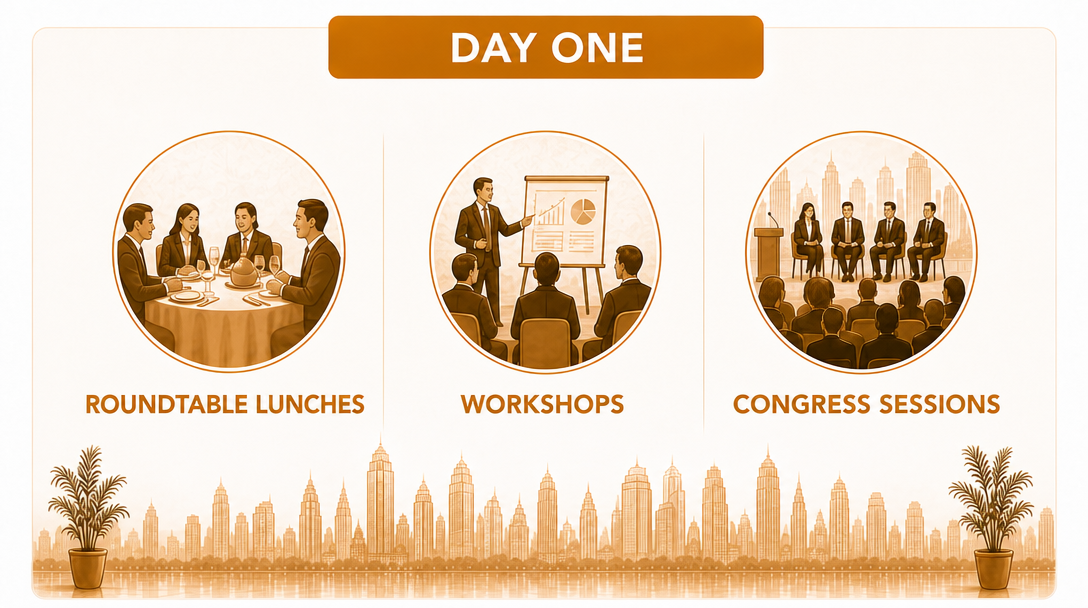
Delegates gain full access to the UAE Banking and Financial Congress, built around the most pressing challenges facing the financial sector today. The day features Roundtable Lunches for intimate, agenda-driven conversations with select partners and peer groups; Workshops that translate keynote thinking into practical strategies delegates can apply immediately; and Partner Sessions delivering thought leadership across banking technology, cybersecurity, and digital transformation.

Gala Dinner

The congress culminates in a spectacular Gala Dinner, an evening of celebration, recognition, and connection. This is where the energy of two days of powerful conversations transforms into something more lasting: relationships cemented, partnerships sparked, and memories made. A fitting close to what will undoubtedly be the region’s most prestigious gathering of banking technology leaders.

Checkout & Beyond

Delegates check out the following morning, a Friday – having experienced two days of exceptional content, networking, and hospitality. For those who wish to extend the experience, the option to continue their stay through the weekend remains open, giving attendees the opportunity to unwind, reflect, and enjoy the venue at their leisure.

Key Themes

Agentic AI in Finance: Autonomous Systems That Plan, Act & Deliver Outcomes

Strengthening trust, security, operational resilience amid regulatory & geopolitical flux

Compliance in the Age of Digital Finance: Embedding Resilience, Transparency & Governance

Trust, Technology, and the Next Phase of UAE Financial Services

Embedded Finance, Platforms & Ecosystems: The Banking-Beyond-Banking Era

Responsible AI by Design: Building Trustworthy, Transparent & Fair Financial Systems

Orchestrating data, analytics & cloud to unlock personalized customer experiences

Reinventing the core infrastructure for agility, scalability and resilience

Partners UAE FSC

Why Partner

The UAE Financial Services Congress brings together the region’s most influential technology decision-makers — CIOs and senior leaders who come ready to evaluate, decide, and invest. For solution providers, it’s a high-impact platform built to drive meaningful conversations, qualified connections, and measurable commercial outcomes. Partner with us to put your brand at the centre of the region’s most important financial technology conversation

Become A Partner
Why Partner

Host Partner

Strategic Partner

Roundtable Workshop Partner

Exhibit Partner