Knowledge Hub / Harvinder Singh

Analyst Spotlight

Harvinder Singh
Chief Business Officer
AceCloud

Analyst Spotlight

The Inflection Point: From Agentic Pilots to Production-Scale Operations

Thirty years in enterprise sales teaches you to tune out the noise. I’ve watched every technology cycle come through and most of them changed something, just not everything, and rarely on the timeline promised but Agentic AI feels different. I am not declaring this because of the hype, but because its failure mode is unlike anything I have seen before and this is where it gets interesting. Enterprises aren’t failing to adopt this technology, they’re failing to scale something they have already proven.


The results from pilots are real. Customer support teams handling 60% more inquiries. Finance operations that process invoices in a fraction of the time. Sales teams qualifying pipeline at a scale no headcount plan could match. The technology works. Yet, 60% of enterprises have evaluated agentic systems, only 20% have progressed to pilots, and just 5% reach full production.

We have seen the pattern constantly. A brilliant pilot launches, delivers results, builds internal momentum then hits a wall at month six. The agent runs in isolation. Systems aren’t connected. Governance frameworks don’t exist. Infrastructure buckles under production workloads. The project stays alive on paper and dies in practice.


This is not a model problem. It is an infrastructure problem.


Agentic systems demand something traditional cloud was never designed for: elastic compute that absorbs agent burst loads without punishing idle costs, data layers that don’t bottleneck under continuous automation workflows, security that enforces governance at the task level and economics that make enterprise-wide deployment viable, not just enterprise-grade pilots. These properties need to work together.


The enterprises winning this aren’t the ones with the most sophisticated agents. They’re the ones that made infrastructure decisions eighteen months ago that turned out to be exactly right for this moment.


At AceCloud, we’re building an AI-first cloud platform designed precisely for this transition. Not retrofitting AI onto existing infrastructure, but architecting from the ground up for what production-scale agentic operations actually demand. As India’s sovereign public cloud, that also means infrastructure enterprises can trust with sensitive data and critical workloads.

The question for CIOs at this summit has moved on. ‘Should we invest in agentic AI?’ is settled. The harder question that will define outcomes over the next three years is, ‘do we have the infrastructure and operational readiness to move from pilot to production at scale?’


That’s the conversation I’m eager to have at the CIO Summit in Chennai.

 

Proceedings

Proceedings

Protected

To access this content, please enter the password you have received from IDC.


Driving Enterprise AI and Insights

Driving Enterprise AI and Insights

Driving Enterprise AI and Insights

In Partnership With

Logo

Overview

India’s rapid digital transformation driven by real-time payments, digital identity platforms, and expanding digital ecosystems, is reshaping how financial transactions, services, and interactions take place. However, this acceleration is also increasing the complexity and scale of fraud, financial crime, and identity-related risks.


Traditional fraud detection approaches often rely on rules and static models that struggle to detect sophisticated schemes spanning multiple accounts, devices, identities, and transactions.

IDC research highlights the growing importance of stronger data foundations for AI-driven risk management. By 2027, organisations that fail to prioritise high-quality, AI-ready data will experience up to a 20% productivity loss, as AI and analytics initiatives struggle with fragmented data environments. At the same time, IDC predicts that end-to-end observability across the data value chain will improve AI proof-of-concept to production success rates by up to 60% in APEJ organisations by 2026.


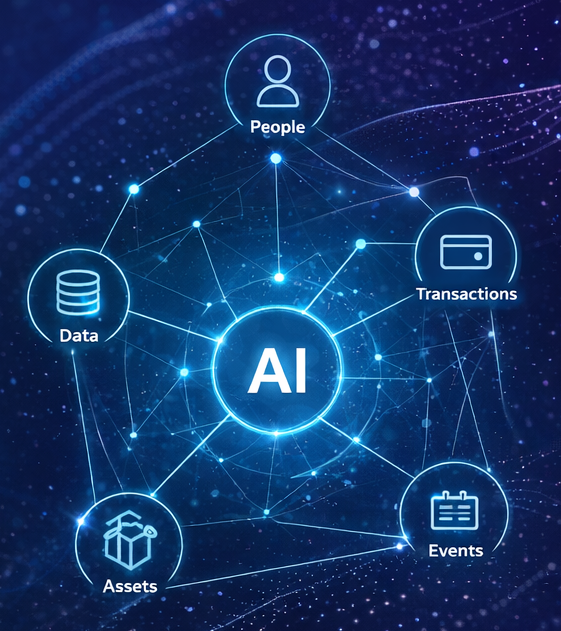
This executive roundtable will bring together CIOs and technology leaders to explore how connected data and graph intelligence are helping organisations uncover hidden fraud patterns, strengthen investigative analytics, and enable AI systems to operate with greater context and accuracy. Drawing on IDC research and enterprise experiences, the discussion will focus on how organisations can build more explainable, context-aware, and scalable fraud detection systems.

Why Attend

  • Gain Research Insights: Learn from IDC’s latest global and APeJ research on AI and GenAI adoption, trends, and enterprise challenges.
  • Understand Connected Data: Discover why connected intelligence is critical for scaling AI and improving decision-making.
  • See Graph Technology in Action: Learn how graph-based approaches help organizations enhance AI accuracy, explainability, and trust.

Agenda

Driving Enterprise AI and Insights

One Day Event

6:00PM

Registration & Networking

6:30PM

Welcome Address

Sakshi Grover

Sakshi Grover

Senior Research Manager, Cybersecurity Products and Services, Asia Pacific, IDC

6:35PM

The Future of Enterprise AI: From Data Silos to Connected Intelligence

As AI adoption accelerates, data silos remain a major barrier to scale. This session explores how enterprises can unify fragmented data, enable real-time insights, and build connected intelligence that drives smarter decisions and business growth.

Sakshi Grover

Sakshi Grover

Senior Research Manager, Cybersecurity Products and Services, Asia Pacific, IDC

6:45PM

The Knowledge Layer for Enterprise AI

Suhail Gulzar

Suhail Gulzar

Head of Solutions Engineering – APAC, Neo4j

Pawan Mall

Pawan Mall

Sr Solution Engineer, Neo4j

7:00PM

Open Discussion: Scaling Trusted GenAI: Why Connected Data Is the Missing Link

Explore how connected, contextual data helps enterprises scale Generative AI responsibly by improving accuracy, trust, and governance while reducing risk.

Sakshi Grover

Sakshi Grover

Senior Research Manager, Cybersecurity Products and Services, Asia Pacific, IDC

8:00PM

Summary & Close

Sakshi Grover

Sakshi Grover

Senior Research Manager, Cybersecurity Products and Services, Asia Pacific, IDC

8:10PM

Dinner and Networking

Speakers

Sakshi Grover

Sakshi Grover

Senior Research Manager, Cybersecurity Products and Services, Asia Pacific

IDC

Read bio

Suhail Gulzar

Suhail Gulzar

Head of Solutions Engineering – APAC

Neo4j

Read bio

Pawan Mall

Pawan Mall

Sr Solution Engineer

Neo4j

Read bio

Partner

In Partnership With

Venue

JW Marriott Hotel New Delhi Aerocity

Meeting Room – Studio 05 & 06
Asset Area 4 – Hospitality District Delhi, Aerocity, New Delhi – 110037

Knowledge Hub / SearchUnify

Partner Spotlight

SearchUnify

Partner Spotlight

Agentic Architecture for Enterprise Customer Support: A Lever for the Outcomes You're Already Accountable For

CIOs in high-stakes industries are managing more competing priorities than ever — security, cloud, data governance, AI risk, workforce transformation. Customer support rarely sits at the top of that stack, and that’s entirely rational. Bandwidth is finite. Every decision to defer something is also a decision to protect something else.


But support carries a quiet cost when deprioritized. When enterprise queries go unresolved, compliance questions fall through the cracks, or renewal conversations stall, the effects don’t stay in the support queue. They surface in churn numbers, audit findings, and board conversations about retention and operational risk — metrics you’re already accountable for, regardless of whether support is on your roadmap.


The question isn’t whether to prioritize support. It’s whether the infrastructure underneath it is quietly undermining outcomes you’re already responsible for.


From Patchwork to Architecture


Most organizations built their current support setup incrementally — a chatbot here, a knowledge base there. The result is fragmented, costly to maintain, and difficult to govern. Agentic systems change the calculus: rather than simply retrieving answers, they reason across context, invoke enterprise tools within a single workflow, and make calibrated decisions about when to resolve autonomously versus when to escalate gracefully to a specialist; with full context intact, not abandoned mid-resolution.


Three design decisions determine whether this works in practice: memory precision (retrieval rigorous enough for regulated environments), tool governance (every action surface scoped and audited like any privileged user), and escalation design treated as a feature, not a fallback. Organizations that get these right see the architecture compound in value over time – building a knowledge layer that becomes increasingly difficult for competitors to replicate.


A Governance Proof Point, Not Another Risk


For CIOs already navigating AI governance at the board level, a well-architected support layer can become a proof point rather than a liability — demonstrating auditability, immutable audit trails, and responsible deployment at scale.


The investment case isn’t built on support transformation for its own sake. It’s built on protecting the resilience, cost control, and risk reduction outcomes you’re already accountable for.


Reimagining the Future of BFSI – PH

Reimagining the Future of BFSI – PH

In Partnership With

Logo

Building Resilient, Intelligent, and Scalable Financial Institutions

The Philippine financial sector has entered its second wave of transformation. Over 50% of large enterprises are operating in the cloud. Seven in ten organisations are deploying GenAI-enhanced applications.


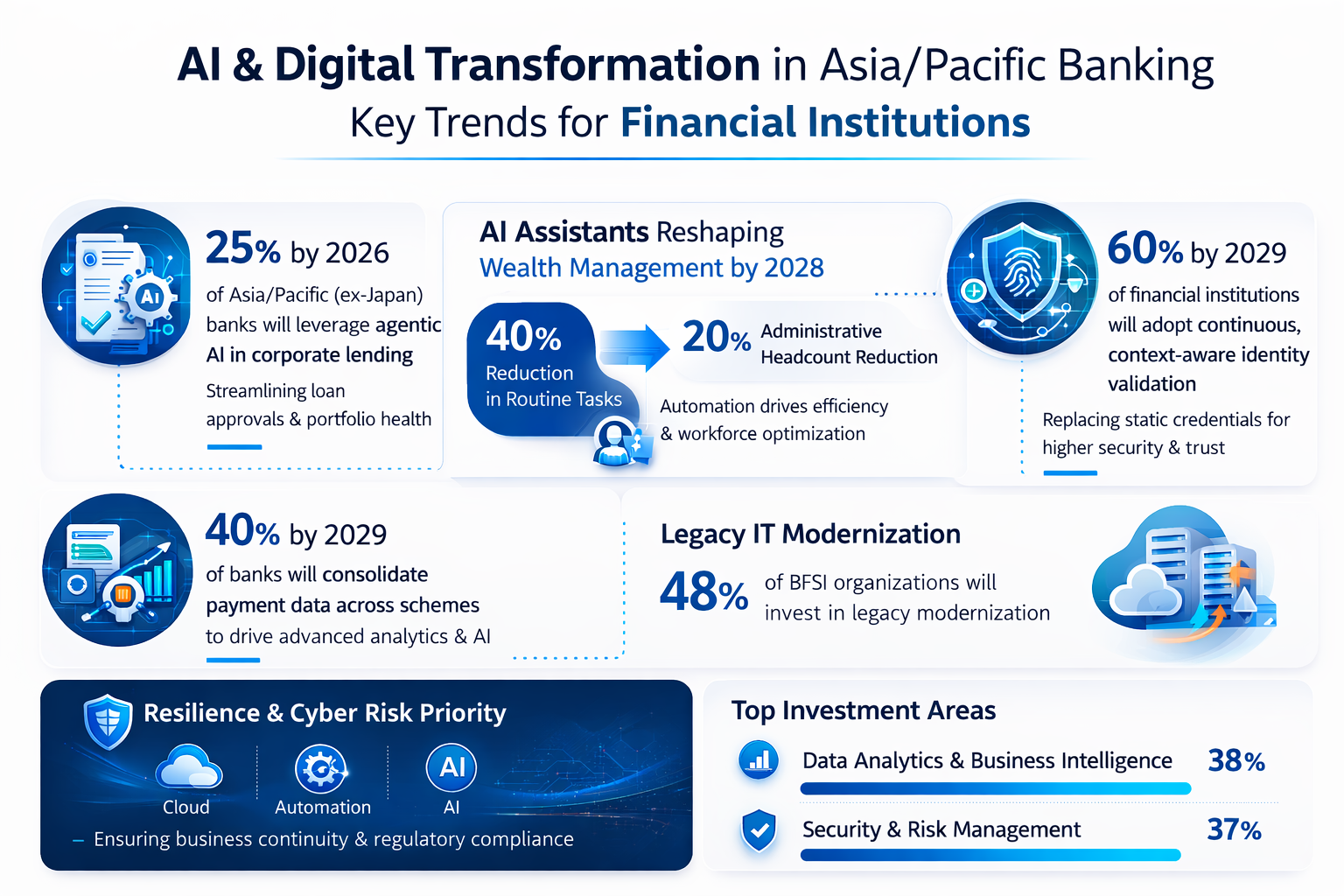
The question is no longer adoption. It is reinvention. By 2026, 25% of Asia-Pacific banks are expected to deploy agentic AI in corporate lending, accelerating approvals, improving portfolio health, and reshaping risk management models.


At the same time, regulatory scrutiny around operational resilience, cyber readiness, and responsible AI governance is intensifying. Innovation without control is no longer viable. Growth must be matched by trust.


Yet nearly half of BFSI institutions across the region are still navigating legacy modernisation, balancing scale with operational continuity.


This executive roundtable convenes CIOs, and Senior IT leaders to examine how Philippine financial institutions can move beyond isolated AI initiatives toward enterprise-wide intelligence embedding resilience, governance, and scalability at the core of transformation.

Strategic Discussion Areas

  • From AI Pilots to Enterprise Intelligence
  • Operational Resilience as a Board-Level Imperative
  • Responsible AI and Governance by Design
  • Legacy Modernisation as a Strategic Growth Lever
  • Data as Institutional Infrastructure

Agenda

Reimagining the Future of BFSI – PH

One Day Event

11:00AM

Registration & Networking

11:30AM

Welcome Address

Matthew Chen

Matthew Chen

Chief Executive Officer, OneConnect Financial Technology (International) ​

11:50AM

Scaling Intelligence with Discipline

Michael Yeo

Michael Yeo

Associate Research Director, Financial Insights, Asia/Pacific IDC

12:00PM

Operationalizing Intelligence: Enabling Secure, Scalable, and Cloud-Ready BFSI Transformation​

Matthew Chen

Matthew Chen

Chief Executive Officer, OneConnect Financial Technology (International) ​

12:20PM

Open Discussion​

1:00PM

Summary & Close​

Matthew Chen

Matthew Chen

Chief Executive Officer, OneConnect Financial Technology (International) ​

1:05PM

Networking Lunch ​

Speakers

Michael Yeo

Michael Yeo

Associate Research Director, Financial Insights

Asia/Pacific IDC

Read bio

Matthew Chen

Matthew Chen

Chief Executive Officer

OneConnect Financial Technology (International) ​

Read bio

Partner

In Partnership With

Venue

Shangri-La The Fort, Manila

30th Street, corner 5th Ave, Taguig, 1634 Metro Manila, Philippines

Room: Pavilion 2, Level 8

Be Part of it!

Register Now

Reimagining the Future of BFSI – ID

Reimagining the Future of BFSI – ID

In Partnership With

Logo

Building Resilient, Intelligent, and Scalable Financial Institutions

Indonesia’s financial sector is expanding at national scale, fueled by rapid digital adoption, ecosystem collaboration, and financial inclusion initiatives.


Between 2026 and 2028, AI is expected to play a defining role in lending, wealth management, and operations. AI assistants alone are projected to reduce up to 40% of routine tasks, reshaping workforce models and cost structures.


This represents both opportunity and exposure. Institutions that scale intelligently will widen their competitive gap. Those that scale without governance risk operational fragility.


Security, risk management, and data governance are now board-level priorities, while nearly half of BFSI institutions across the region are modernising legacy systems to enable platform-based growth.


This roundtable brings together CIOs, and Digital Leaders, and Senior Technology leaders to explore how Indonesia’s financial institutions can align growth ambition with operational discipline, ensuring intelligence, resilience, and scalability evolve together.

Strategic Discussion Areas

  • Scaling Agentic AI in High-Volume Financial Environments
  • Resilience and Risk in a Hyper-Growth Market
  • Platform-Based Architecture for Ecosystem Expansion
  • Modernisation to Enable Inclusion and Sustainable Scale
  • Data and Governance as Strategic Assets

Agenda

Reimagining the Future of BFSI – PH

One Day Event

11:00AM

Registration & Networking

11:30AM

Welcome Address

Matthew Chen

Matthew Chen

Chief Executive Officer, OneConnect Financial Technology (International) ​

11:50AM

Scaling Intelligence with Discipline

Michael Yeo

Michael Yeo

Associate Research Director, Financial Insights, Asia/Pacific IDC

12:00PM

Operationalizing Intelligence: Enabling Secure, Scalable, and Cloud-Ready BFSI Transformation​

Matthew Chen

Matthew Chen

Chief Executive Officer, OneConnect Financial Technology (International) ​

12:20PM

Open Discussion​

1:00PM

Summary & Close​

Matthew Chen

Matthew Chen

Chief Executive Officer, OneConnect Financial Technology (International) ​

1:05PM

Networking Lunch ​

Speakers

Michael Yeo

Michael Yeo

Associate Research Director, Financial Insights

Asia/Pacific IDC

Read bio

Matthew Chen

Matthew Chen

Chief Executive Officer

OneConnect Financial Technology (International) ​

Read bio

Partner

In Partnership With

Venue

InterContinental Jakarta Pondok Indah

Jalan Metro Pondok Indah Kav.IV TA, Jl. Kartika Utama, RT.1/RW.16, Pd. Pinang, Kec. Kebayoran Lama, Kota Jakarta Selatan, Daerah Khusus Ibukota Jakarta 12310, Indonesia

Room: The Studio 4, Level 2

Agenda

Beyond ‘Wait for Certainty’: A Practical Playbook for Modernizing CRE

One Day Event

11:00AM

Registration & Networking

11:30AM

Welcome Address

Bryan Ma

Bryan Ma

Vice President – Devices Research, Asia/Pacific, IDC

11:35AM

From Uncertainty to Action: Modernizing CRE

From Uncertainty to Action: Modernizing CRE” explores how organizations can navigate volatility in today’s business environment by transforming Corporate Real Estate (CRE) into a strategic, data-driven function. The discussion highlights key challenges—shifting workplace dynamics, economic uncertainty, and evolving employee expectations—and outlines actionable approaches to modernize portfolios through technology, flexible space strategies, and smarter decision-making. Attendees will gain practical insights on turning ambiguity into opportunity, enabling CRE to drive resilience, efficiency, and long-term value.

Bryan Ma

Bryan Ma

Vice President – Devices Research, Asia/Pacific, IDC

11:45AM

Beyond ‘Wait for Certainty’: A Practical Playbook for Modernizing CRE

A Practical Guide to Modernizing CRE Now” focuses on actionable steps organizations can take to rapidly evolve their Corporate Real Estate (CRE) function in today’s dynamic environment. The discussion cuts through theory to provide clear, real-world strategies—leveraging data, adopting flexible workplace models, optimizing portfolios, and integrating smart technologies. Attendees will learn how to prioritize initiatives, drive immediate impact, and build a more agile, cost-efficient, and future-ready CRE strategy.

Vivek Satpathi

Vivek Satpathi

Head of Client Growth and Technology Sales, APAC & EMEA, JLL

12:00PM

Open Discussion

1:00PM

Summary & Close

1:15PM

Networking Lunch

Beyond ‘Wait for Certainty’: A Practical Playbook for Modernizing CRE

Beyond ‘Wait for Certainty’: A Practical Playbook for Modernizing CRE

Beyond ‘Wait for Certainty’

In Partnership With

Logo

A Practical Playbook for Modernizing CRE

Modern corporate real estate is shifting from a facilities function to a strategic capability that influences agility, productivity, risk, and experience. Yet many organizations still operate CRE through fragmented data, manual processes, and siloed decision-making, creating a gap between what leadership expects from the workplace and what current operating models can deliver.


This roundtable is designed as a peer dialogue for CRE and IT leaders to align on what modern CRE looks like today, the building blocks of modern CRE, how maturity evolves from manual operations to predictive and orchestrated workplace management, and the steps that help organizations progress without waiting for perfect certainty. Participants will compare approaches to governance, data readiness, and value measurement. They will also map the intelligent workplace ecosystem (what needs to connect) across CRE, IT, HR, Finance, and operational systems, so modernization is anchored in end-to-end workflows and defensible outcomes (not point solutions). The goal is to leave with a clear set of questions and near-term actions that support CRE–IT alignment and a stronger C-suite narrative beyond cost alone.


Agenda

Beyond ‘Wait for Certainty’: A Practical Playbook for Modernizing CRE

One Day Event

11:00AM

Registration & Networking

11:30AM

Welcome Address

Bryan Ma

Bryan Ma

Vice President – Devices Research, Asia/Pacific, IDC

11:35AM

From Uncertainty to Action: Modernizing CRE

From Uncertainty to Action: Modernizing CRE” explores how organizations can navigate volatility in today’s business environment by transforming Corporate Real Estate (CRE) into a strategic, data-driven function. The discussion highlights key challenges—shifting workplace dynamics, economic uncertainty, and evolving employee expectations—and outlines actionable approaches to modernize portfolios through technology, flexible space strategies, and smarter decision-making. Attendees will gain practical insights on turning ambiguity into opportunity, enabling CRE to drive resilience, efficiency, and long-term value.

Bryan Ma

Bryan Ma

Vice President – Devices Research, Asia/Pacific, IDC

11:45AM

Beyond ‘Wait for Certainty’: A Practical Playbook for Modernizing CRE

A Practical Guide to Modernizing CRE Now” focuses on actionable steps organizations can take to rapidly evolve their Corporate Real Estate (CRE) function in today’s dynamic environment. The discussion cuts through theory to provide clear, real-world strategies—leveraging data, adopting flexible workplace models, optimizing portfolios, and integrating smart technologies. Attendees will learn how to prioritize initiatives, drive immediate impact, and build a more agile, cost-efficient, and future-ready CRE strategy.

Vivek Satpathi

Vivek Satpathi

Head of Client Growth and Technology Sales, APAC & EMEA, JLL

12:00PM

Open Discussion

1:00PM

Summary & Close

1:15PM

Networking Lunch

Speakers

Bryan Ma

Bryan Ma

Vice President – Devices Research, Asia/Pacific

IDC

Read bio

Vivek Satpathi

Vivek Satpathi

Head of Client Growth and Technology Sales, APAC & EMEA

JLL

Read bio

Partner

In Partnership With

Venue

Hilton Singapore Orchard

Meeting Room: Tembusu

333 Orchard Rd, Singapore 238867

Be Part of it!

Register Now

Knowledge Hub / CtrlS

Analyst Spotlight

Analyst Spotlight

AI, Regulation, and Energy: 9 Datacenter Priorities CXOs Must Prepare for in 2026

In 2026, datacenter strategy is no longer reacting to change; it is being shaped by it. AI workloads are intensifying, energy is becoming scarce, and regulation is tightening across regions. For CXOs, infrastructure can no longer sit quietly in the background as a utility. Growth now depends on how well power access, efficiency, compliance, resilience, and workload realities are aligned from day one.


So what does that actually mean in practice?


It comes down to nine priorities that will define how datacenters are planned, built, and scaled in the years ahead.


1. AI-driven infrastructure scaling is no longer linear
The old CPU-led model assumed predictable, steady growth. AI breaks that assumption. Workloads are spiky, rack densities are extreme, and demand can surge overnight. Infrastructure planning must become modular and flexible, allowing capacity to scale incrementally without disrupting live environments. Designing for high-density GPU clusters is now foundational.


2. Power availability has become the single biggest strategic constraint
Land and capital matter, but electricity now decides where growth is even possible. Grid access timelines, substations, and long-term power contracts are shaping expansion decisions. With datacenter electricity demand projected to nearly double by 2030, energy planning has moved firmly into the boardroom.


3. Energy efficiency must become AI-aware
Traditional metrics like Power Usage Effectiveness (PUE) still matter, but they no longer tell the full story. AI workloads behave differently, drawing power in peaks rather than steady cycles. Real efficiency now depends on workload-level visibility, knowing which models, GPUs, and clusters consume how much power, and when.


4. Cooling has turned into a strategic differentiator
As rack densities rise, air cooling reaches its limits. Liquid cooling, direct-to-chip, and hybrid approaches are fast becoming the norm. Cooling failures remain one of the leading causes of outages, making thermal design a mission-critical decision.


5. Clean energy is no longer a side initiative
Customers, regulators, and investors increasingly expect verifiable renewable usage. Power procurement strategies (PPAs, captive generation, and hybrid energy models) directly influence scalability, compliance, and uptime.


6. Regulatory readiness must be built in
Energy reporting mandates, AI governance frameworks, and data sovereignty rules are expanding and diverging globally. Retrofitting compliance later is expensive and risky. Future-ready datacenters embed auditability and policy alignment at the design stage.


7. Resilience must be viewed globally
High-density environments amplify the impact of failures, while supply chains and geopolitics introduce new vulnerabilities. Redundancy alone is no longer enough; resilience must span infrastructure, policy, and procurement.


8. Operating models must evolve
AI infrastructure sits at the intersection of power engineering, thermal management, automation, and compliance. Traditional IT operations are stretched thin. New skills, orchestration frameworks, and intelligent automation are now essential.


9. Financial discipline becomes a core strategy
AI infrastructure carries volatile operating costs, rapid hardware refresh cycles, and exposure to energy price fluctuations. RoI calculations must factor in performance, energy risk, and regulatory uncertainty; not just upfront cost.


Together, these priorities reflect a simple reality: in the age of AI, infrastructure success is defined as much by constraints as by ambition.


To learn more about how CtrlS is building future-ready datacenter infrastructure, visit: https://www.ctrls.com

Knowledge Hub / Githen Ronney

Analyst Spotlight

Githen Ronney
SAP Analytics – Practice Head
Blueprint Technologies

Analyst Spotlight

The Difference Between Data and Insight

When we talk about data, we often assume that numbers speak for themselves. In reality, they don’t. A number without context can easily mislead—even if it is technically correct.


I’ve seen situations where a dashboard shows a sharp increase in sales, and the immediate reaction is to celebrate. But when you look closer, it turns out to be a one-time bulk order or a seasonal effect. Without that context, the data is not just incomplete—it’s misleading. The same applies to almost every KPI we track. Metrics only start making sense when you understand the business situation behind them.


From an analytics perspective, context comes from dimensions like time, region, customer segment, and business process. A drop in revenue, for example, might look like a problem until you realize a product line was intentionally phased out. If the analyst or decision-maker doesn’t know this, the insight becomes noise.


This challenge becomes even more critical in AI and machine learning. Models learn from historical data, but they don’t inherently understand business reality. If the data lacks context, the model will still find patterns—but those patterns may not be meaningful. In one case, a churn model flagged several high-value customers as risks, simply because it didn’t consider long-term contracts. Technically, the model was correct based on the data—but practically, it was wrong.


Another common issue is how data is defined across systems. In many organizations, the same
metric—like “revenue” or “customer”—is calculated differently in different systems. When these are combined without a common understanding, it leads to conflicting insights. This is where context, especially in the form of business definitions and semantic layers, becomes essential. Without it, even advanced analytics platforms struggle to deliver consistent results.


There is also a growing expectation around explainability. Business users don’t just want predictions; they want to know why something is happening. A number or a prediction without explanation is hard to trust. Context bridges that gap—it connects data to real business scenarios.


At the end of the day, data on its own doesn’t create value. It’s the interpretation, backed by business context, that drives decisions. Analytics and AI can process massive volumes of data, but without context, they are just producing outputs—not insights.


In my experience, the real shift happens when organizations stop focusing only on data collection and start focusing on making data meaningful. That’s where the true value lies.