Knowledge Hub / Essa Haidar

CXO Spotlight

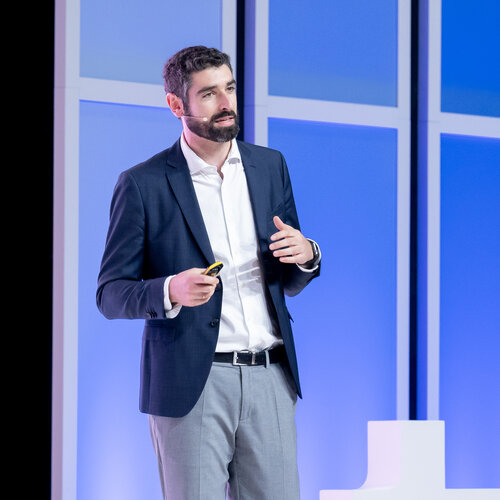
Essa Haidar
Chief Technology Officer
Ooredoo

CXO Spotlight

Intelligent Networks, Intelligent Enterprises: Leading in the Age of AI Native Infrastructure

The digital economy is entering a decisive new phase — one where competitiveness is no longer determined by connectivity alone, but by intelligence built directly into infrastructure. Around the world, executive leaders are shifting from traditional transformation programs to a more ambitious mandate: creating enterprises that can sense, decide, and act in real time. This next frontier is defined by two powerful forces converging at scale: next‑generation networks and applied AI woven throughout the enterprise fabric.


The Network Becomes Intelligent: The 5G‑Advanced Era


Over the past decade, global operators made extraordinary strides advancing mobile broadband. Now, the leap to 5G‑Advanced (5G‑A) and 5G Standalone (5G SA) marks the most consequential shift since LTE. More than 180 operators are on track to deploy these capabilities by 2025, a signal that the industry has reached an inflection point.


5G‑A brings an immediate 20–30% improvement in network efficiency, delivering higher capacity and better user experience. Meanwhile, 5G SA — built on a fully cloud‑native architecture — achieves single‑digit millisecond latency, making real‑time industrial control, robotics, and immersive experiences commercially viable. Cloud‑native cores reduce energy per bit by 30–50%, drive faster innovation cycles, and streamline lifecycle management.


But the true transformation lies in the Service‑Based Architecture (SBA) underpinning 5G SA. This architecture is inherently programmable, enabling networks to behave less like infrastructure and more like intelligent digital systems.


Two capabilities exemplify this shift:


NWDAF — From Transport Layer to Decision Engine


The Network Data Analytics Function (NWDAF) infuses machine‑learning‑based analytics directly into the 5G core. It continuously monitors behavior, predicts mobility and traffic patterns, allocates resources intelligently, and automates policy decisions. In effect, NWDAF turns the network into an AI‑powered decision engine, capable of self‑optimization and real‑time experience assurance.


NEF — Exposing Intelligence to the Ecosystem


The Network Exposure Function (NEF) opens network capabilities securely to developers and enterprises. Through standardized APIs, organizations gain access to quality‑on‑demand, slicing control, real‑time analytics, location data, and event triggers that enable new industry applications. NEF transforms the network from a connectivity provider into a platform for ecosystem innovation.


Together, NWDAF and NEF redefine what a network can be — moving operators beyond bandwidth economics into the era of intelligent digital services.


AI at Scale: The Enterprise’s New Growth Engine


If 5G SA represents the digital nervous system, AI is the intelligence that activates it. Across industries, CEOs and technology leaders are now centering their strategies on three AI‑driven impact pillars:


1. Operational Efficiency That Moves the P&L


AI‑driven automation is delivering returns once considered aspirational: up to 35% OPEX reduction through predictive maintenance and automated configuration, over 20% improvement in capacity planning accuracy, and 30–50% fewer outages thanks to proactive anomaly detection and root‑cause acceleration. Efficiency is no longer a cost‑cutting exercise — it is a catalyst for reinvestment and growth.


2. Customer Experience Orchestrated, Not Managed


AI agents resolve 60–70% of engagement scenarios, enabling human experts to focus on complex needs. Predictive detection prevents issues before they reach the customer, cutting complaints by 25–40%. Personalized digital journeys deliver 15–25% conversion gains. Enterprises are evolving from reactive service models to proactive, end‑to‑end experience orchestration.


3. New Revenue Through Intelligent Network Services


Dynamic slicing, edge computing, and AI‑driven charging are expected to generate USD 130–150 billion globally by 2030. Industry‑specific applications — especially in logistics, manufacturing, and healthcare — now rely on real‑time network intelligence. With NEF‑enabled API monetization, operators are emerging as strategic enablers of national and sector‑wide digital transformation.


Advanced Compute: Accelerating AI for Every Enterprise


To unlock these capabilities, enterprises are modernizing their compute environments. Demand for GPU‑accelerated infrastructure is growing at 30%+ CAGR, driven by large‑scale training, inference, and real‑time analytics. Smart datacenters equipped with NVIDIA‑class GPUs deliver 3–10× faster training, secure AI experimentation, and high‑density efficiency. GPU‑as‑a‑Service models further democratize access, removing CAPEX barriers and speeding adoption.


The Path Forward: Building the AI‑Native Enterprise


The convergence of next generation networks, AI at scale, and GPU‑accelerated compute signals the dawn of the AI‑native enterprise. For leaders, the mandate is clear: build intelligent networks, activate enterprise‑wide AI, and transform infrastructure into a platform for innovation and growth.


Those who do will define the next era of digital leadership.

IDC and Neo4j Roundtable

19 May 2026 The St. Regis Singapore

IDC and Neo4j Roundtable

From Data Chaos to AI Confidence

19 May 2026 The St. Regis Singapore

In Partnership With

Logo

How Enterprises Are Turning Connected Data into Real Business Value

As enterprises scale AI from experimentation to production, a critical gap is emerging – AI systems are only as reliable as the data context behind them. Many organisations are discovering that traditional data architectures built to store data, not relationships, are limiting their ability to deliver accurate, explainable, and scalable AI outcomes.


Recent IDC research shows that organisations adopting graph-based approaches are seeing 44% fewer GenAI hallucinations, 53% faster queries, and achieving a 230% ROI with a payback period of just 7.8 months. At the same time, they are unlocking millions in annual business value by enabling new use cases, improving decision-making, and accelerating time to market.


This closed-door executive roundtable brings together CIOs and senior technology leaders to engage in an interactive discussion with peers on how to evolve their data and AI strategies from fragmented data environments to trusted, context-rich intelligence platforms.

Why Attend

  • Gain Research Insights: Learn from IDC’s latest global and APeJ research on AI and GenAI adoption, trends, and enterprise challenges.
  • Understand Connected Data: Discover why connected intelligence is critical for scaling AI and improving decision-making.
  • See Graph Technology in Action: Learn how graph-based approaches help organisations enhance AI accuracy, explainability, and trust.

Agenda

IDC and Neo4j Roundtable

One Day Event

11:30 am

Registration, Tea/Coffee & Networking

12:00 pm

Welcome Address

Xander Smart

Xander Smart

General Manager – ASEAN, Neo4j

Mark Woodhams

Mark Woodhams

Chief Revenue Officer, Neo4j

12:10 pm

From Data Chaos to AI confidence: How Enterprises are Turning Connected Data into Real Business Value

As AI adoption accelerates, data silos remain a major barrier to scale. This session explores how enterprises can unify fragmented data, enable real-time insights, and build connected intelligence that drives smarter decisions and business growth.

Sandra Ng

Sandra Ng

Senior Vice President, WW and APJ Research, IDC

12:25 pm

Graph Intelligence in Action: Real-World AI Use Cases Across Industries

Graph intelligence is transforming how organizations uncover relationships, detect patterns, and generate actionable insights.

Philip Rathle

Philip Rathle

Chief Technology Officer, Neo4j

12:40 pm

Open Discussion: Scaling Trusted GenAI: Why Connected Data Is the Missing Link

Explore how connected, contextual data helps enterprises scale Generative AI responsibly by improving accuracy, trust, and governance while reducing risk.

Sandra Ng

Sandra Ng

Senior Vice President, WW and APJ Research, IDC

Philip Rathle

Philip Rathle

Chief Technology Officer, Neo4j

1:25 pm

Summary and Close

Xander Smart

Xander Smart

General Manager – ASEAN, Neo4j

1:30 pm

Lunch and Networking

Speakers

Sandra Ng

Sandra Ng

Senior Vice President, WW and APJ Research

IDC

Read bio

Philip Rathle

Philip Rathle

Chief Technology Officer

Neo4j

Read bio

Mark Woodhams

Mark Woodhams

Chief Revenue Officer

Neo4j

Read bio

Xander Smart

Xander Smart

General Manager – ASEAN

Neo4j

Read bio

Partner

IN PARTNERSHIP WITH

Venue

The St Regis Singapore

Meeting Room: Embassy & Consulate, Level 1
29 Tanglin Rd, Singapore 247911

The New Era of AI Operations

The New Era of AI Operations

In Partnership With

Logo

Designing the Human + Digital Workforce Operating Model

As enterprises scale AI adoption across the organization, they are entering a new phase of transformation: From Experimentation to Outcomes.


By 2026, IDC forecasts that 40% of enterprise roles will work directly with AI agents, fundamentally reshaping how work is executed, measured, and optimized. In this new reality, CIOs and CHROs face a shared challenge: how to design and operationalize a human + digital workforce with clear accountability, strong governance, and measurable impact. 


This exclusive, closed-door roundtable, co-hosted by IDC and Darwinbox, brings together senior technology and HR leaders to explore how organizations can move beyond isolated AI pilots to a scalable AI operating model; one where AI is embedded directly into business processes and enterprise workflows, delivering real outcomes rather than standalone experimentation. 


Grounded in IDC’s global research and enterprise benchmarks and informed by Darwinbox’s experience enabling AI-driven workforce transformation at scale, the discussion will focus on how organisations can design AI work layer that balance innovation speed with accountability, governance, and measurable business outcomes. 

Key Discussion Areas

  • How to embed AI into core business processes to drive measurable outcomes  
  • Defining roles and accountability in a human + digital workforce
  • Building a strong data foundation and context to support AI-driven decisions  
  • Balancing innovation with governance, risk, and compliance  
  • Measuring business impact and ROI from AI transformation initiatives 

Agenda

The New Era of AI Operations

One Day Event

11:00 am

Registration & Networking

11:30 am

Welcome Address

11:35 am

AI-Driven Operations: Building a Unified Human–Machine Operating Model

Deepika Giri

Deepika Giri

Associate Vice President, IDC

11:50 am

Running an AI-Native Enterprise: From Experimentation to Execution with Governance and Scale

Sriram Nedunuri

Sriram Nedunuri

Associate Director – Strategic Pursuits, Darwinbox

12:10 pm

Open Discussion

12:55 pm

Summary & Closing

1:00 pm

Lunch & Networking

Speakers

Deepika Giri

Deepika Giri

Associate Vice President

IDC

Read bio

Sriram Nedunuri

Sriram Nedunuri

Associate Director – Strategic Pursuits

Darwinbox

Read bio

Partners

Venue

Park Hyatt Kuala Lumpur

Warisan Merdeka Tower, Presint Merdeka 118, Wilayah Persekutuan, 50118 Kuala Lumpur, Federal Territory of Kuala Lumpur

Salon 6, Level 98

Be Part of it!

Register Now

IDC Webinar On Demand – HPE Brasil

IDC Webinar On Demand – HPE Brasil

Transformando Redes em Ativos Estratégicos

Patrocinado por

Logo

Sobre o evento

Em um cenário de hiperconectividade, novos workloads, IA generativa e ambientes cada vez mais distribuídos, as redes deixaram de ser apenas infraestrutura — tornaram-se fundamentais para habilitar inovação, eficiência e segurança. Neste encontro, discutiremos tendências, desafios e caminhos práticos para preparar as redes para 2026 e além.


Principais tópicos que serão explorados:

  • Tendências e fatores externos que estão redefinindo decisões tecnológicas em 2026
    (IA generativa, segurança, geopolítica, nuvem e economia digital)
  • Prioridades estratégicas de TI identificadas pelas pesquisas IDC
    (GenAI/AI Agents, Cloud Security, AI/ML e infraestrutura em nuvem)
  • A evolução das redes: da manutenção ao modelo “Customer Success Embedded Life Cycle Services”
  • Alta complexidade e hiperconectividade
    – desafios de visibilidade, resiliência, segurança e gestão de redes híbridas

Speakers

Luciano Saboia

Luciano Saboia

Director Telecommunications, Latin America

Read bio

Antenor Nogara

Antenor Nogara

Country Manager

HPE Networking

Read bio

Partners

Patrocinado por

Inscreva-se aqui

Não perca seu lugar neste evento único e cheio de conhecimento

Registre-se

AI at Scale: The Next Phase of Enterprise Transformation

AI at Scale: The Next Phase of Enterprise Transformation

Partners

Logo Logo

Overview

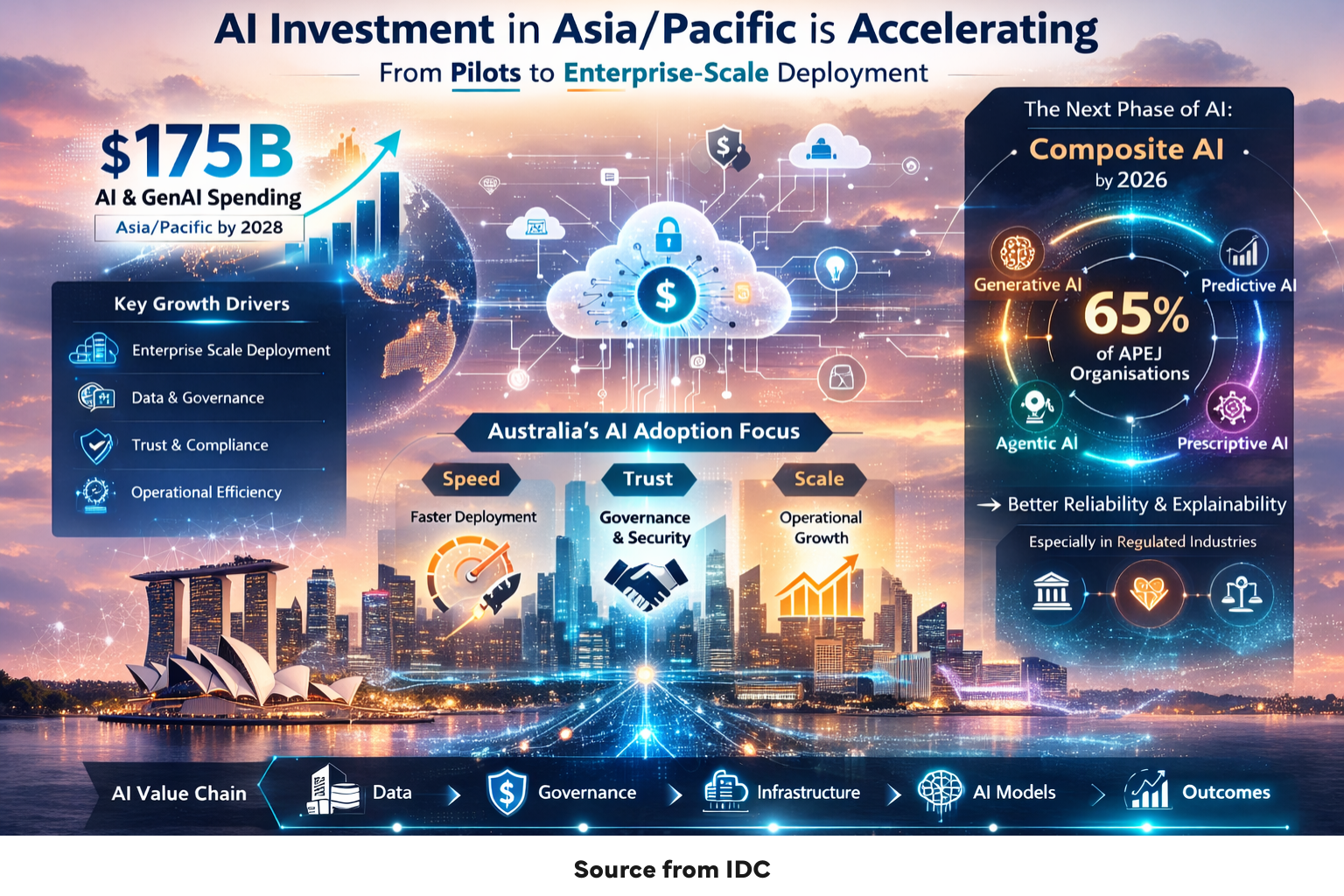
AI investment across Asia/Pacific is accelerating rapidly, with IDC forecasting $175 billion in AI and GenAI spending by 2028, as organisations move from pilots to enterprise-scale deployment. For Australian organisations, the next phase of AI adoption is focused on speed, trust, and operational scale. 

At the same time, by 2026, 65% of APEJ organisations will adopt composite AI, combining generative, predictive, prescriptive, and agentic AI to improve reliability and explainability, particularly in regulated industries. 


Scaling AI also depends on infrastructure and data readiness. IDC forecasts that organisations that fail to prioritise high-quality, AI-ready data will experience a 20% productivity loss when scaling generative and agentic AI solutions. As a result, Australian enterprises are increasingly investing in hybrid and multicloud platforms, secure data foundations, and governance frameworks to operationalise AI at scale. 


This invitation-only executive roundtable brings together Australian CIOs and senior IT leaders to explore how AI can be industrialised across the enterprise, delivering measurable value while managing risk and compliance. 

What’s in it for You?

  • Exposure to AI Readiness Assessment developed by IDC and commissioned by Lenovo, offering insights to help organisations unlock their full AI potential
  • Access IDC research-backed insights on scaling AI across the enterprise
  • Learn how peers are accelerating time-to-value while maintaining governance and trust
  • Exchange practical approaches to AI evaluation, data readiness, and infrastructure strategy
  • Understand how composite AI and industrialised platforms are shaping the next phase of enterprise transformation
What’s in it for You?

Agenda

AI at Scale: The Next Phase of Enterprise Transformation

One Day Event

8:30 am

Registration, Tea/Coffee and Networking

9:00 am

Welcome Address

James Robertson

James Robertson

Sales Director, Public Sector & Enterprise, Lenovo

9:05 am

Securing the AI-Driven Enterprise: Infrastructure, Data, and Trust

As enterprises accelerate AI adoption, security must evolve beyond traditional perimeters to protect intelligent, data-driven ecosystems. This session explores how organisations can build resilient AI-ready infrastructure, ensure data integrity and governance, and embed trust through explainability, observability, and compliance-by-design.

Linus Lai

Linus Lai

Group Vice President, Research, IDC

9:20 am

CIO Playbook 2026​ The Race for Enterprise AI

AI is no longer measured by efficiency gains alone—it is now a critical driver of business growth, competitive advantage, and reinvention. Today’s CIOs are under increasing pressure to demonstrate how AI delivers tangible business outcomes, moving beyond technical success to real, measurable impact across the organisation.

James Robertson

James Robertson

Sales Director, Public Sector & Enterprise, Lenovo

9:30 am

Open Discussion: Scaling AI for Enterprise Impact: From Strategy to Secure Execution

AI impact requires more than strategy—it demands secure, scalable execution. This discussion session highlights how organisations can align business priorities, modernise data and infrastructure, and embed governance to deliver trusted AI at scale.

Linus Lai

Linus Lai

Group Vice President, Research, IDC

James Robertson

James Robertson

Sales Director, Public Sector & Enterprise, Lenovo

10:05 am

Summary and Close

Linus Lai

Linus Lai

Group Vice President, Research, IDC

Speakers

Linus Lai

Linus Lai

Group Vice President, Research

IDC

Read bio

James Robertson

James Robertson

Sales Director, Public Sector & Enterprise

Lenovo

Read bio

Partners


Venue

Sheraton Grand Sydney Hyde Park

161 Elizabeth St, Sydney NSW 2000, Australia

Located in the Sydney CBD opposite Hyde Park, it offers luxury amenities with comfort for an executive roundtable session.

Partners

HCL Software


Host Partner

Ping Identity & IT Smart Systems

Strategic partner

Cloudera

Tech Talk Partner

vSoft

Tech Talk Partner

Coursera

Tech Talk Partner

Workday

Tech Talk Partner

Oobeya

Tech Pitch Partner

Partners

HCL Software

Host Partner

Ping Identity & IT Smart Systems

Strategic partner

Cloudera

Tech Talk Partner

vSoft

Tech Talk Partner

Coursera

Tech Talk Partner

Workday

Tech Talk Partner

Oobeya

Tech Pitch Partner

Knowledge Hub / Vivek Ganesh

Partner Spotlight

Vivek Ganesh
RVP
OutSystems India

Partner Spotlight

The Enterprise AI Reality Check: 6 Predictions for 2026

Based on conversations with several CIOs about their biggest challenges (and hopes) as they look ahead to 2026, I learned some unexpected things along the way. What I learnt challenges much of the prevailing wisdom from AI prognosticators.


Here are 10 surprising, and perhaps controversial, predictions based on these conversations that point to where our industry may truly be headed.


1. AI will increase complexity before it reduces it


What most people aren’t seeing today is the potential for AI to help with the harder stages of the enterprise software development lifecycle. They are overindexing on the build phase, but creating bottlenecks downstream in quality control, security, maintenance, and updates.


2026 will be the year IT teams turn their focus to containing and auditing ungoverned AI-generated apps and agents. Those who use AI to systematically govern their full portfolio will be the first to realize the true potential of AI-driven development.


2. Most AI agents will fail in production


Demos of autonomous AI agents are spectacular. Unfortunately, these demos crumble when they meet an enterprise production environment, and this is likely to get worse soon.Most autonomous agents will need tight orchestration layers and human-in-the-loop controls. In other words, they’ll need new platforms. Autonomy only works in fantasy. It’s orchestration that wins in reality.


3. The enterprise winners will be platforms, not models


The days when every company was racing to build their own LLM have passed. While a handful of big LLMs will dominate the mass market for consumer AI, enterprise leaders will be able to choose among more specialized options and even develop agents that connect to more than one LM for different scenarios. Owning the model matters less than owning the lifecycle.


4. AI will shift value from feature delivery to system integrity


The risks (data leaks, hallucinations, policy violations etc.)of unmanaged AI running rampant without enterprise-grade guardrails are too great to ignore.The ability to ensure correctness at scale becomes more important than the ability to generate software. The market will reward platforms that can ensure AI-driven systems behave as intended, every single time.


5. Shadow AI will become a bigger problem than shadow IT ever was


The fact that non-technical users can generate production code and workflows with LLMs is far more dangerous than unauthorized SaaS adoption. Without any oversight at all, a business user with an unvetted LLM can generate production-level code, create autonomous workflows, or exfiltrate sensitive enterprise data. This risk is insidious, viral, and incalculable.


6. CIOs will spend more on control and governance, not less


AI promises deflation even in the face of inference costs. But the reality will be re-inflation of IT budgets to offset New security layers, New model oversight, New compliance obligations, and New skills


The real opportunity


To recap, the future of software development is one where:


– AI accelerates output

– SaaS and bundled software lose their grip on the enterprise

– Architecture, security, and governance get harder

– Platforms that manage complexity gain relevance

– Enterprise value shifts from code to lifecycle management

– Non-tech companies will manage a growing portfolio of software IP

– The future belongs to platforms that help them bring order to AI-generated chaos.

Integration Executive Forum

Integration Executive Forum

Impulsando la empresa agéntica.

Patrocinado por

Logo

La aceleración digital, la adopción de la nube y la rápida evolución de la IA han multiplicado la complejidad tecnológica en las organizaciones. Plataformas desconectadas, integraciones rígidas y modelos poco escalables siguen siendo un freno para la innovación y la generación de valor.


El 24 de marzo, IBM e IDC reúnen a líderes tecnológicos y responsables de TI en una jornada pensada para analizar cómo una estrategia de integración moderna puede eliminar fricciones, optimizar costes y sentar las bases para escalar la IA empresarial con seguridad y control.


A través de la visión conjunta de expertos de IBM y analistas de IDC, abordaremos los principales retos a los que se enfrentan hoy las áreas de TI y cómo están respondiendo las organizaciones más avanzadas.
Déjese sorprender y regístrese a una jornada en la que además de disfrutar tendrá la oportunidad de aprender y charlar con líderes del sector.


Agenda

Integration Executive Forum

One Day Event

9:30 am

Registro y café de bienvenida

10:00 am

Bienvenida y apertura

Luis Fernandes

Luis Fernandes

Senior Research Manager, Infrastructure, IDC Europe

Javier Roncero

Javier Roncero

Javier Roncero, Director de software de Automatización, IBM

10:05 am

Tendencias clave en integración y automatización IT: estrategias de modernización de las empresas líderes

Luis Fernandes

Luis Fernandes

Senior Research Manager, Infrastructure, IDC Europe

10:25 am

Transformando la infraestructura tecnológica en un motor real de crecimiento

Las organizaciones invierten el 67% de su presupuesto IT en transformación digital. Sin embargo, existe una brecha crítica entre inversión y resultados: el 95% de las compañías no obtiene retornos de sus iniciativas de IA, según el MIT. Exploramos las claves para cerrar esta brecha y convertir la tecnología en un verdadero catalizador de crecimiento del negocio.

Bruno Braz

Bruno Braz

Director de soluciones de Integración, IBM

10:50 am

Unifica tu negocio con visibilidad y control en tiempo real

La fragmentación de sistemas y múltiples patrones de integración limita la visibilidad y aumenta el riesgo operativo. En esta sesión con demo en directo veremos cómo IBM webMethods Hybrid Control Plane unifica gobierno, seguridad y cumplimiento desde un único punto de control, simplificando la gestión y proporcionando visibilidad completa en tiempo real.

José Miguel Indave

José Miguel Indave

Director Técnico de soluciones de Integración, IBM

11:20 am

Coffee Break

11:40 am

Mesa Redonda: Automatización con IA: eficiencia, innovación y resiliencia

La explosión de aplicaciones y datos, aumentada ahora por los LLMs y la IA Agéntica, ha provocado un “caos de conectividad” que frena los resultados de la automatización. En esta mesa redonda con expertos debatiremos cómo la integración inteligente desbloquea el valor de los datos e impulsa la eficiencia operativa real.

Luis Fernandes

Luis Fernandes

Senior Research Manager, Infrastructure, IDC Europe

Ignacio Basanta

Ignacio Basanta

Responsable de ventas de soluciones de Integración, IBM

José Luis Teja

José Luis Teja

Senior Account Technical Leader, IBM

12:00 pm

Preparados para la IA Agéntica

Para escalar la IA empresarial con confianza, la integración es un factor crítico de doble impacto: la integración como habilitador para desplegar las iniciativas de IA de forma segura; y la IA agéntica integrada dentro de las propias herramientas de integración para multiplicar la productividad y acelerar resultados. Terminaremos con una demo del uso de  Agentes de Integración dentro de la plataforma iPaaS (integración como servicio) de IBM

José Miguel Indave

José Miguel Indave

Director Técnico de soluciones de Integración, IBM

12:30 pm

Conclusiones

Bruno Braz

Bruno Braz

Director de soluciones de Integración, IBM

Luis Fernandes

Luis Fernandes

Senior Research Manager, Infrastructure, IDC Europe

12:40 pm

Networking y cóctel

Ponentes

Luis Fernandes

Luis Fernandes

Senior Research Manager, Infrastructure

IDC Europe

Read bio

José Miguel Indave

José Miguel Indave

Director Técnico de soluciones de Integración

IBM

Read bio

Bruno Braz

Bruno Braz

Director de soluciones de Integración

IBM

Read bio

Ignacio Basanta

Ignacio Basanta

Responsable de ventas de soluciones de Integración

IBM

Read bio

Javier Roncero

Javier Roncero

Javier Roncero, Director de software de Automatización

IBM

Read bio

José Luis Teja

José Luis Teja

Senior Account Technical Leader

IBM

Read bio

Patrocinado por

Lugar

Restaurante Élkar

Élkar, el restaurante más alto de España, a 160 metros de altura en la planta 33 de Torre Emperador Castellana. Con las mejores vistas de Madrid, y un ambiente exclusivo, Élkar es un destino imprescindible para amantes de la buena comida.

Restaurante de alta gastronomía vasca, cuya propuesta nace de la unión entre dos chefs de reconocido prestigio como son Sergio Ortiz de Zárate, Estrella Michelin y Beñat Ormaetxea, Premio Nacional de Jóvenes Chef.

Torre Emperador Castellana, P.º de la Castellana, 259D, Planta 33, 28046 Madrid

IT Security Summit

IT Security Summit

Securing an AI-Powered Business

25 Jun 2026 Milan, Italy
Slide
Slide
Slide
Slide

Navigating the new frontier of trust, compliance and innovation

The IDC IT Security Italy 2026 is the definitive event for business, security, and technology leaders to explore how to embed trust, governance, and resilience at the core of digital transformation.

Italy is entering a pivotal stage in its cybersecurity and digital modernization journey. According to IDC, European security spending is forecast to grow at a compound annual rate of around 9.4% through 2029, with software, analytics, and cloud-native protection leading the market. In Italy, organizations are responding to rising cyber threat activity, expanded EU regulatory requirements, as well as growing national efforts to strengthen digital sovereignty and critical infrastructure resilience.
At the same time, AI is transforming Italy’s security landscape. IDC research shows that nearly 40% of European organizations are already investing in AI or automation, and more than 70% expect AI-driven disruption within the next 18 months.

For Italian security leaders, AI represents both an opportunity and a growing area of risk. It is improving threat detection, incident response, and automation, but it is also enabling new attack vectors such as deepfakes, AI-generated phishing, and automated exploitation. In response, Italian organizations are investing in AI-driven analytics, identity and access management (IAM), and managed detection and response (MDR) to enhance protection while maintaining transparency, governance, and ethical AI adoption.

Agenda

The IDC IT Security Summit, is the ultimate meeting point for business, security, and technology leaders looking to embed trust, governance, and resilience at the heart of their digital transformation strategies.

Join IDC analysts and industry experts to explore how to build trusted digital ecosystems that combine innovation with assurance. Gain insights into Italy’s most dynamic sectors and walk away with actionable frameworks to make security a strategic differentiator, not just a reactive cost.

Main Themes

Regulation, Resilience and Value Creation​

Regulatory compliance is no longer a back-office burden, it’s a strategic enabler. We will explore how organizations can embed regulatory mandates (data privacy, cybersecurity laws, emerging AI/tech rules) into core operations, turning requirements into levers for resilience, stakeholder trust, and business value. Keytopics include cyber-by-design, auditability, vendor accountability, and continuity in the face of disruption.

AI, Automation & Responsible Innovation

AI and intelligent agents are transforming how security is delivered, but with great power comes risk. We will explore pragmatically deploying AI: governance models, guardrails for misuse, prioritization of high-impact use cases, and aligning AI systems with trust, transparency, and accountability.

Operations, Analytics and Resilience Engineering

Detection, response, and recovery are now continuous cycles rather than discrete events. We’ll delve into advanced analytics, managed detection & response, orchestration, external threat visibility (supply chain, third parties), and resilience metrics to operationalize security effectiveness.

The Human Factor: Leadership and Culture

Technology alone doesn’t guarantee security. Leadership, culture, and skill development must align. We will focus on transforming teams, embedding security ownership across functions, and equipping leaders to speak the language of risk and trust to the board, CEOs, and business lines.

Incident and Trust Recovery

Breaches will happen, but what matters is how an organization responds. We will cover crisis communication, forensic response, regulatory handling, insurance, stakeholder trust restoration, and turning adversity into credibility.

Sector and Domain Security Challenges

Different industries and environments pose unique security demands. We will focus on securing critical infrastructure (energy, utilities), connected devices and IoT, healthcare, finance, and emerging environments like smart cities or industrial systems.

Venue

Magna Pars Event Space

Via Tortona 15, 20144, Milan – Italy


Speaker

Roberta Bigliani

Roberta Bigliani

Group Vice President, Global Lead for Energy & Retail Insights and Industry Hub

IDC

Read bio

Joel Stradling

Joel Stradling

Research Director, European Security

IDC

Read bio

Stefano Righetti

Stefano Righetti

Head of IT Governance, Information Security & Strategy

Acciaierie d'Italia

Read bio

Marco D’Elia

Marco D’Elia

Country Manager

Sophos Italia

Read bio

Marco Frenquellucci

Marco Frenquellucci

Group Leader, Italy, Service & Solution Group

Lenovo

Read bio

Luca Della Giovanna

Luca Della Giovanna

Chief Information Security Officer

Humanitas

Read bio

Andrea Gilli

Andrea Gilli

Senior Advisor Office of Undersecretary of Italian Defence & Lecturer in Strategic Studies

University of St Andrews

Read bio

Our Partners

How to join

The event, which will take place on June 25, 2026 starting at 9:00 am is free of charge (upon filling the registration form), for professionals in the following sectors: Manufacturing, Automotive, Fashion, Finance, Banking and Insurance, Retail, Energy and Utilities, Media, Government, Health, Education, Transports, Logistics, Telecommunications, Personal and Professional Services.

Access to the event is not allowed for non-sponsoring ICT companies (vendor, distributors, reseller, VAR, system integrator), ICT consultancy and services companies, private individuals and freelancers.

The official language of the event is Italian.

Knowledge Hub

The NIS 2 directive – where are we now?

The deadline for the transposition of the EU’s second Network and Information Systems Security directive (NIS 2) came and went in October 2024 with only a handful of member states having completed the task.

Read more

European ICT spending implications of NATO’s 5% GDP spending target

At the 2025 NATO Summit in The Hague a few weeks ago, member states pledged to allocate 5% of their annual GDP to core defense requirements and defense- and security-related expenditures by 2035.

Read more

IAM 2025: The Rise of the Machines

Identity and access management (IAM), and by extension, identity security, is one of the most pervasive and impactful challenges facing all European organizations today, from an operational and risk management perspective.

Read more